The short answer
Yes, rabbits can eat ripe persimmon flesh, in treat-sized amounts. Persimmon is a sweet fruit, and fruit is the smallest slice of a rabbit's diet: the House Rabbit Society puts fruit below 5% of the daily diet and calls it a treat, with vegetables at around 10% and hay at 80%. So the persimmon question is really a portion question, with one extra catch that is specific to this fruit: unripe persimmons carry tannins that make the flesh astringent, and ripeness is the variable you control.
- Safe part: the fully ripe flesh, cut into a piece a rabbit can pick up.
- Portion: a small wedge inside the treat allowance, not a fruit a day.
- Frequency: once or twice a week at most, counted with every other fruit and treat.
- Skip it for: kits under 12 weeks, any rabbit in a gut episode, and any rabbit carrying extra weight.
- Never: dried persimmon, jam, pudding or any sweetened product, and never the leaves or twigs of the tree.
If your rabbit is new to fruit altogether, start with the new greens guide first. Fruit is the last thing a rabbit needs in its diet and the easiest thing to over-serve.
Ripe or unripe: what the tannins do
What astringency is
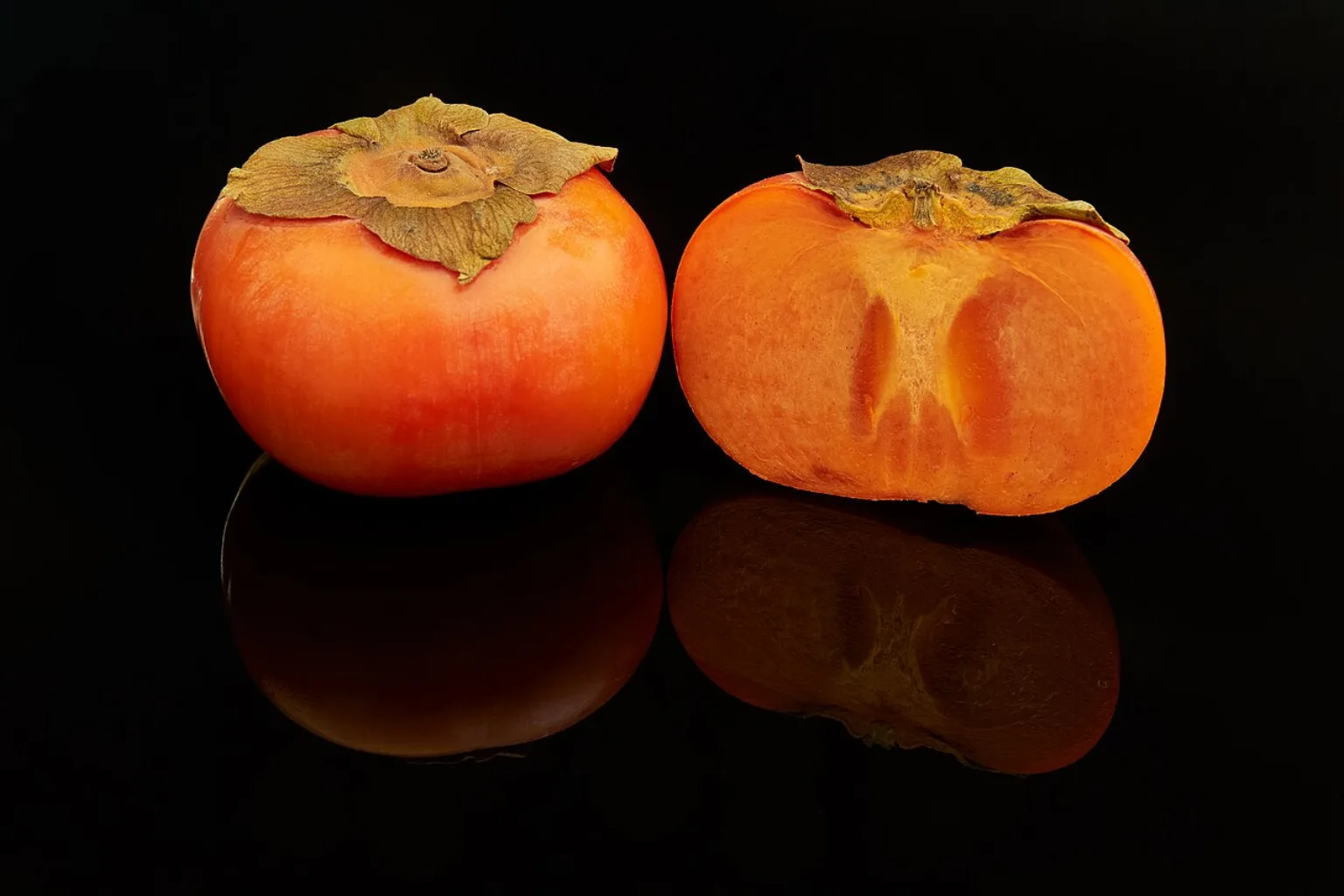
Persimmons are classified by what their unripe flesh does to a mouth. The University of Florida's IFAS extension publication on persimmon astringency explains that astringency is a sensation caused by tannins in the unripe flesh, described as making the mouth feel dry, causing puckering, numbing the tongue and constricting the throat, and that it decreases as the fruit ripens until it is no longer present in fully ripe fruit. Those tannins are condensed tannins, also called proanthocyanidins, and they sit in the cells of the fruit's flesh. As the fruit ripens they polymerize, which makes them insoluble and takes the astringency away.
| Variety class | Examples named in the UF/IFAS publication | What that means before it reaches a rabbit |
|---|---|---|
| Non-astringent | Fuyu, Jiro | Can be eaten from firm through soft stages, so a firm fruit is already usable |
| Astringent | Hachiya, Tanenashi | Cannot be eaten at the firm stage; wait until the flesh is fully soft and sweet |
The practical rule follows from that: if a piece of persimmon makes your own mouth pucker, it is not ripe enough for a rabbit either. Do not let the rabbit make that decision, either. Rabbits are willing eaters and will often nibble an astringent fruit that a person would put down, and a food that is unpleasant rather than dangerous is still a food the rabbit did not need.
How to ripen an astringent persimmon
Ripening is simple to do without any special equipment. The same extension publication gives room-temperature ripening as the simplest method for astringent types, since the tannins polymerize as the fruit softens, and it notes that freezing at about minus 4 degrees Fahrenheit (minus 20 Celsius) also polymerizes the tannins, which is useful if you already have frozen persimmon. Either way, the feeding rule is unchanged: ripe flesh, small piece, treat frequency.
How much persimmon can a rabbit eat?
No authority publishes a persimmon-specific number, so this table is our own working mapping, built inside the published rules rather than instead of them: fruit below 5% of the daily diet at the House Rabbit Society, treats in very small amounts at PDSA, and the RWAF fruit list marked occasional treats only.
| Rabbit weight | Persimmon piece | Frequency | What else counts that day |
|---|---|---|---|
| 2 lb (small dwarf) | A piece the size of a fingernail | Once a week at most | No second fruit item that day |
| 4 lb | One thin wedge, seeds removed | Once or twice a week | Skip the carrot piece that day |
| 5 lb (typical adult) | One thin wedge, seeds removed | Once or twice a week | Count it against any other fruit |
| 8 lb | One larger wedge | Twice a week | Still inside the same small allowance |
| 10 lb and over (large breed) | One larger wedge | Twice a week | Large rabbits are not exempt from sugar limits |
Two details make the piece smaller in practice than it looks on paper. First, a whole Fuyu persimmon is a large fruit, so one fruit covers many weeks of treats for a single rabbit. Second, the treat allowance is shared: a slice of apple on Tuesday and a persimmon wedge on Wednesday is two fruit days, not one of each kind of food.
Why sugar is the real limit
The reason fruit is capped so tightly is not calories in the human sense. The House Rabbit Society's nutrition page on treat foods explains that excessive sugar is either converted to fat or passes into the cecum, where the bacteria use it and can overgrow, possibly leading to bacterial imbalance and GI stasis. The same page notes that the problem can follow too much fruit specifically, and recommends keeping sweets to an occasional small snack rather than a routine.
That is why persimmon belongs in the same category as banana and apple rather than beside cucumber or romaine. A rabbit's gut is built for long fiber, and the everyday diet that protects it is hay first, greens second, pellets measured, fruit last.
What belongs in the bowl, part by part
| Part | Rabbit suitability | Note |
|---|---|---|
| Ripe flesh | Yes, as a small treat | Soft, sweet and sugary; the portion is the whole point |
| Skin | Fine on ripe fruit | Wash the fruit first; no need to peel a fully ripe persimmon |
| Seeds and calyx | Remove | Hard, inedible parts have no place in a bowl |
| Leaves, twigs and bark | No | Not on any of the safe-food lists used here; fresh branches for rabbits should come from species you have confirmed |
| Dried persimmon, jam, pudding, cake | No | Concentrated sugar, plus often added sugar and dairy |
Introducing persimmon safely
The introduction rules are the same ones that apply to every new food. The House Rabbit Society's guidance is to offer one new food at a time and wait 24 hours, watching for soft stools or gas, and to stop that food if either appears. Kits under 12 weeks should not be getting fresh fruit or vegetables at all yet.
The first serving
- One piece, one day, no other changes. Same hay, same pellets, no second new food.
- Serve it at room temperature and cut it small. Cold fruit straight from the fridge is less appealing and harder to judge.
- Check the litter tray for 24 hours. Round, firm, plentiful droppings are the pass mark.
- Watch for sticky leftovers. Sweet fruit that sticks around the mouth or chin is a reason to offer less next time, not more.
- Stop if anything changes. Soft droppings, a quiet rabbit, or a rabbit that leaves its hay means the treat is out for now.
When to skip persimmon
Fruit is optional, which makes it the easiest thing to remove when anything else is going on. Skip persimmon, and fruit in general, in these situations:
- A rabbit with soft droppings or a recent gut episode. Rebuild on hay and settled greens first.
- A rabbit that is overweight or losing weight. Both need a vet conversation rather than treats.
- A rabbit that is refusing hay. Sweet food makes hay less appealing, and hay is the food that keeps teeth and gut working.
- A rabbit on a vet-managed diet. Follow the vet's plan, which may exclude fruit entirely.
- A kit under 12 weeks. Fresh foods wait, and fruit waits longest.
If a rabbit has stopped eating, that is not a moment to tempt it with fruit. A rabbit that has eaten nothing for 12 hours is a veterinary emergency, and the not eating guide and the GI stasis guide both cover what to do first.
What to feed on the other days
On the other days, the fruit simply is not there. The diet is the ordinary one: unlimited grass hay, a measured fresh portion built from leafy greens and herbs, a small pellet ration and water. When you want a training treat, a leaf of basil or a small piece of cucumber does the job without spending the day's sugar allowance.
Useful next steps: the safe food checker for a quick yes or no on a specific food, the diet planner to see how a treat fits around your rabbit's actual weight, the banana guide and tomato guide for the same treat arithmetic on other sweet foods, and the beginner diet guide for the hay-first structure underneath all of it.
References and further reading
- University of Florida IFAS Extension, HS1483: alleviating astringency in persimmon fruit: the astringent and non-astringent variety classes with named examples, the tannins in the unripe flesh, what astringency does, and how ripening and freezing reduce it.
- Rabbit.org (House Rabbit Society): vegetables and fruits for rabbits: fruit as a treat below 5% of the daily diet, hay at 80%, vegetables at around 10%, and the one new food per day rule with a 24 hour wait.
- Rabbit.org (House Rabbit Society): treat foods: why rapidly fermented starch and sugar that reach the cecum can lead to bacterial overgrowth and stasis, and the case for vegetable and herb treats over sweet ones.
- Rabbit Welfare Association & Fund: recommended vegetables and herbs: the fresh vegetable share of the diet, the brassica caveats, and the fruit list marked occasional treats only.
- PDSA: feeding your rabbits: hay at around 85% of the diet, the twice-daily handful of greens, and treats in very small amounts.
Related resources
Diet & Nutrition
Can Rabbits Eat Cucumber? Water Content, Portions, and Peels
Cucumber is safe for rabbits in small pieces, but at roughly 96% water it stays a small extra. Portions by weight, plus peel, seeds, and leaves.
Diet & Nutrition
Can Rabbits Eat Mung Bean Sprouts? Portions, Washing, and Sprout Safety
Mung bean sprouts are on the House Rabbit Society safe list. How much to feed, why raw sprouts need cold storage and rinsing, and which sprout products to skip.
Diet & Nutrition
Can Rabbits Eat Spinach? Oxalates, Portions, and How Often
Spinach is safe for rabbits in a rotation, not a daily bowl: it is high in oxalates. Portions by weight, how often to offer it, and when to skip it.

Diet & Nutrition
Can Rabbits Eat Tomatoes? Leaves, Green Parts, and Safe Amounts
Ripe fruit only, in tiny amounts — leaves, stems, and unripe tomatoes are not safe. Portions, first-feeding steps, and vet-source links.