The short answer
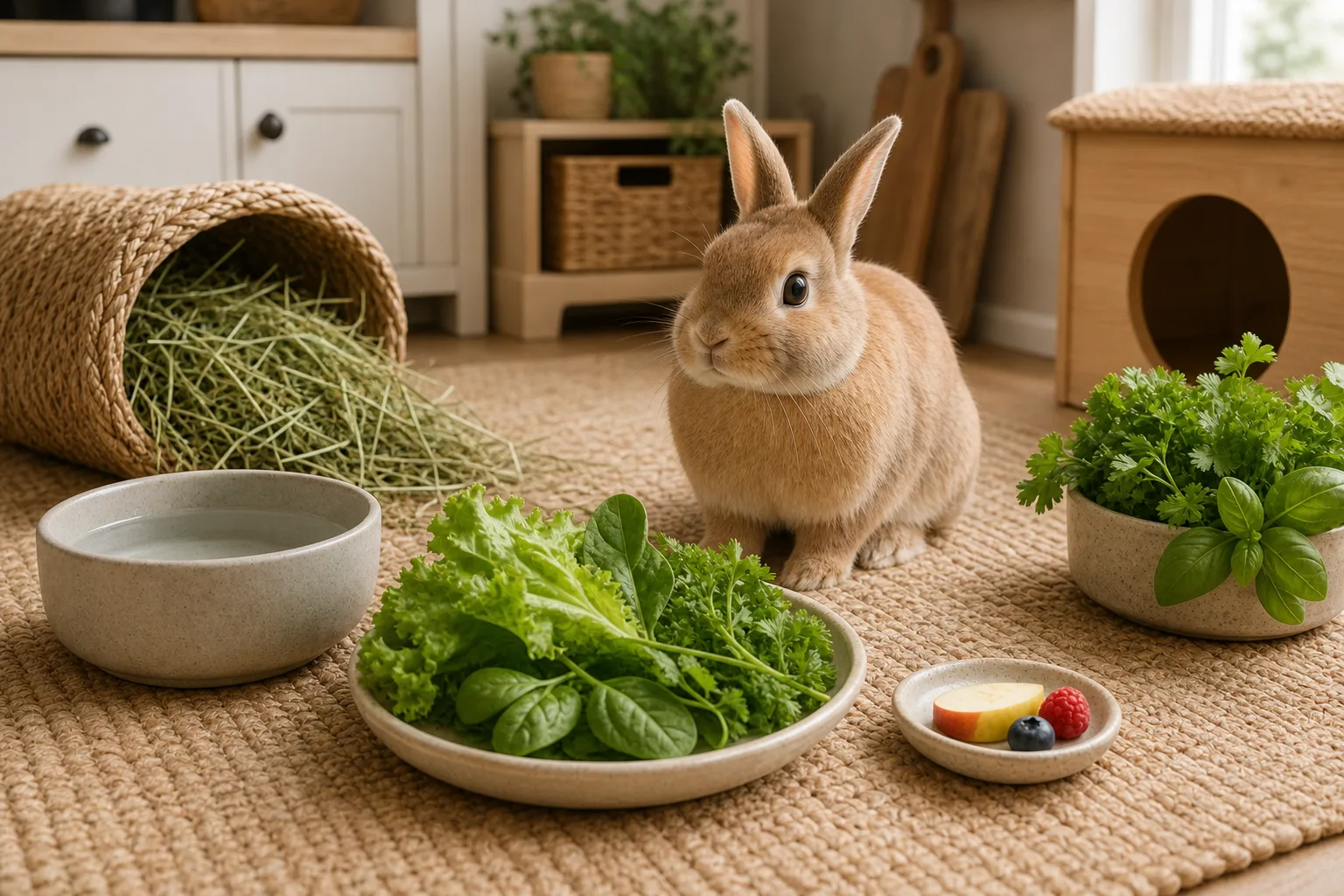
A healthy rabbit diet is built from four things, and the order of size matters more than any single food choice. Hay and grass are the base of the plate, fresh greens are a measured addition, pellets are a supplement, and fruit or treats are occasional. Rabbit.org puts hay at 80 to 85% of an adult rabbit's diet; PDSA, the UK veterinary charity, puts it at around 85% and asks for a bundle at least the size of the rabbit every day.
The daily plate, largest first:
- Hay or grass, unlimited. Not a rack topped up now and then, but a pile the rabbit can graze from whenever it wants.
- Fresh greens and vegetables, roughly 10%. Leafy greens dominate, with a smaller share of non-leafy vegetables.
- Pellets, roughly 5%. A plain, high-fibre, timothy-based pellet, measured rather than poured.
- Fruit, carrots, and treats, under 5%. A very small amount once or twice a week, not a daily extra.
Water sits beside all four with no percentage attached: constant access to clean, fresh water, offered in a bowl if your rabbit will use one, since a bowl is easier to check and clean than a bottle spout and a stuck nozzle is invisible.
The daily plate: what the proportions actually mean
Percentages are easy to nod along to and hard to apply, partly because the two most cited rabbit organisations describe the same plate in different units. The House Rabbit Society in the United States writes in proportions of the diet; PDSA in the United Kingdom writes in spoonfuls and handfuls.
| Part of the plate | House Rabbit Society (Rabbit.org) | PDSA (UK) |
|---|---|---|
| Hay and grass | 80 to 85% of an adult rabbit's diet, offered in large unlimited amounts daily | Around 85%, ideally unlimited, with at least a bundle the size of the rabbit each day |
| Fresh vegetables | About 10%, roughly 1 to 2 cups of vegetables for every 4 lb (1.8 kg) of body weight | An adult-sized handful of leafy greens, vegetables, and herbs twice daily |
| Pellets or nuggets | About 5%, a plain high-fibre timothy-based pellet with a minimum of 18% fibre | One tablespoon once daily, or twice daily for rabbits over 3.5 kg (about 7.7 lb) |
| Fruit and treats | Under 5%; a very small amount once or twice per week. Carrots count as treats | Treats kept small and occasional; sugar-rich foods strictly rationed |
| Variety target | At least three types of leafy green selected daily | Five to six different types of fresh plant, grass, or vegetable every day |
The pellet gap is the real difference between these two sets of guidance: a tablespoon of nuggets is a fraction of what many owners scoop out, and it is the most common place where a rabbit diet quietly drifts away from hay.
How much to feed at each weight
Percentages do not tell you what goes in the bowl, so Rabbit.org publishes a rule of thumb that does: approximately one cup of packed greens for every two pounds of rabbit, with non-leafy vegetables at around one tablespoon per two pounds of body weight. Treat it as an approximate band, not a measuring instruction. PDSA's pellet rule is a flat tablespoon, doubling only over 3.5 kg.
| Rabbit weight | Packed fresh greens | Non-leafy share (cucumber, pepper, carrot top) | Pellets or nuggets | Hay |
|---|---|---|---|---|
| 2 lb (0.9 kg) | About 1 cup | About 1 tbsp | 1 tbsp once daily | Unlimited |
| 4 lb (1.8 kg) | About 2 cups | About 2 tbsp | 1 tbsp once daily | Unlimited |
| 5 lb (2.3 kg) | About 2.5 cups | About 2 to 3 tbsp | 1 tbsp once daily | Unlimited |
| 8 lb (3.6 kg) | About 4 cups | About 4 tbsp | 1 tbsp twice daily | Unlimited |
| 12 lb (5.4 kg) | About 6 cups | About 6 tbsp | 1 tbsp twice daily | Unlimited |
Let two readings decide your adjustments: droppings and body condition. Rabbit.org notes that smaller, darker droppings are a sign a rabbit should be eating more hay, and that too many vegetables can produce runny stools, in which case the greens portion gets tightened. The Rabbit Diet Planner does the same arithmetic from your rabbit's weight, and the safe foods library is the place to check a specific item before it goes in the bowl.
Hay: the part most owners underfeed
Hay is not bedding and it is not filler. It does three jobs at once:
- It wears the teeth. Rabbit teeth grow continuously, and the side-to-side grinding of chewing long-strand hay is what keeps molars from overgrowing.
- It keeps the gut moving. The cecum needs a steady fibre supply, and a hay-poor diet is the most common upstream cause of GI stasis.
- It moves swallowed fur through. This matters most during a heavy molt, which is why hay intake and shedding season get discussed together.
Practical habits: keep unlimited hay in more than one clean place, put a pile where your rabbit toilets (rabbits graze while they poop, which is why litter box hay gets eaten in far greater quantity than hay in a distant rack), and judge a batch by smell before price. Choosing the best hay for rabbits covers which grass hay suits which rabbit.
Greens and vegetables
Fresh food is the smallest part of the plate that still counts as food rather than a treat. Rabbit.org asks for at least three types of leafy green daily and says leafy greens should be roughly 75% of the fresh portion; PDSA recommends five to six different fresh plant types every day. Three rules keep greens safe:
- One new green at a time, then wait 24 hours. If droppings stay normal, the food suits your rabbit. If they turn soft, stop that vegetable and keep everything else steady.
- Serve them wet. Rabbit.org recommends wet vegetables because they raise water intake; washing also removes the pesticide residue that PDSA names as a reason never to feed an unidentified plant.
- Rotate rather than repeat. A few greens fed daily forever is how mineral imbalance and oxalate load creep in. The cucumber guide shows the portion arithmetic for a high-water vegetable, and introducing new greens covers the day-by-day method.
Kits have their own rule: Rabbit.org says vegetables should only be offered after 12 weeks of age, introduced one at a time and in quantities under 1/2 oz, because a kit's digestive system is not finished developing.
Pellets: a measured supplement, not the meal
Pellets are concentrated, convenient, and easy to overfeed. Rabbit.org quotes veterinarian Dr. Susan Brown on the risk: uncontrolled feeding of a pelleted diet to a house rabbit can lead to obesity, heart and liver disease, chronic diarrhea, and kidney disease, because pellets are calorie-dense, low in fibre, and high in calcium compared with hay.
- Plain, uniformly coloured, timothy-based pellets. Rabbit.org asks for a minimum of 18% fibre, and a plain pellet means the rabbit cannot pick favourites.
- Not mixes with nuts, seeds, grains, or colourful pieces. Rabbit.org warns these are high in carbohydrates and invite selective eating, which unbalances the diet.
- Not muesli-style mixes standing in for hay. PDSA advises against muesli food for the same reason.
If you switch brand or type, shift the ratio over several days rather than swapping overnight; moving a rabbit to a healthier diet covers the transition.
Treats, fruit, and carrots
This is the part of the plate most likely to grow without anyone deciding to grow it. Rabbit.org puts fruit at under 5% of the daily diet, treats at a very small amount once or twice a week, and lists carrots in the treat category alongside fruit because of their sugar content. The useful reframing is that a treat is a training tool, not a food group: a thumbnail-sized piece of apple used as a reward does more for your rabbit than a bowl of fruit. If your rabbit begs, the answer is more hay and more enrichment rather than a bigger treat, and boredom signs and solutions covers the swap.
Foods that are not safe
Rabbit.org's list of foods to keep out of the bowl is specific: chocolate, cookies, crackers, breakfast cereals, bread, pasta, and yogurt drops or other human treats. They are marketed as bonding snacks and are the wrong fuel for a hindgut fermenter.
- Processed human food in any form, including baked goods, dairy, and sugary rabbit yoghurt drops.
- Mown grass, which PDSA singles out because it ferments quickly in the gut. Grazed grass is fine; a pile from the mower is not.
- Any plant you cannot identify, or anything that has had pesticide, herbicide, or fertiliser on it.
Before offering something new, check it against the Safe Food Checker or the safe foods library. It takes seconds and it is the difference between a varied diet and an avoidable problem.
Feeding by life stage
The plate keeps its shape across a rabbit's life, but the exceptions move:
| Life stage | What changes |
|---|---|
| Kit, under 12 weeks | No vegetables before 12 weeks; introduce one type at a time under 1/2 oz. Hay is available as soon as the kit eats on its own |
| Growing kit to about 7 months | Alfalfa can have a role while growing; it is a legume, not a grass, and it is too rich for healthy adults |
| Healthy adult | Grass hay unlimited, greens according to weight, a tablespoon-scale pellet portion, treats occasional |
| Nursing, overweight, or frail rabbits | Nursing does need unlimited pellets and hay; overweight rabbits need fewer pellets; older or underweight rabbits may need more calorie-dense food |
Long-haired breeds and rabbits with chronic gut conditions are the other exceptions. Every row here is a place for a rabbit-savvy vet, because the right answer depends on the individual rabbit.
Changing a diet safely
Rabbit digestion is built for consistency, and both organisations make the same point: change slowly. A rabbit moved from muesli and pellets to a hay-first diet overnight can end up with soft droppings or a refusal to eat.
- Change one thing at a time. Pellets this week, greens next week, so you know what caused any reaction.
- Shrink the pellet portion gradually while keeping hay unlimited, so appetite has somewhere to go.
- Add greens one type at a time and watch droppings for 24 hours before adding the next.
- Weigh the rabbit weekly during the transition. Gradual weight loss means you moved too fast.
- Stop if appetite drops. That is a veterinary concern, not a diet-tuning problem; see the warning signs when a rabbit stops eating.
How to tell it is working
You do not need a laboratory to judge a rabbit diet. Four signals tell you most of what you need to know:
- Droppings. Round, plentiful, and roughly uniform. Rabbit.org treats smaller, darker droppings as a cue to increase hay, and uneaten soft cecotropes as a signal worth investigating.
- Appetite. Hay disappears daily and meals are met with interest. A sudden drop in appetite is the earliest and most reliable illness signal a rabbit gives.
- Weight and body condition. A steady weekly weight, with a spine you can feel but not see.
- Teeth and coat. Regular vet checks for molar overgrowth, plus a clean, mat-free coat.
If two or more of those signals drift, the first change to make is more hay and fewer extras. If droppings stop or appetite collapses, that is urgent veterinary care. The everyday rhythm is in building a daily care routine.
References and further reading
Every number in this guide comes from the sources below rather than general pet advice online.
- Rabbit.org (House Rabbit Society): Rabbit Diet and Nutrition - the 85% hay / 10% vegetable / 5% pellet / under 5% treat structure and the special-needs list.
- Rabbit.org: Best Vegetables for Rabbits - the one cup of packed greens per two pounds rule and the 75% leafy share.
- Rabbit.org: The Importance of Hay - why hay sits at the base of the diet.
- PDSA: Feeding your rabbits - the UK veterinary guidance, from the tablespoon nugget rule to the mown grass warning.
Related resources
Diet & Nutrition
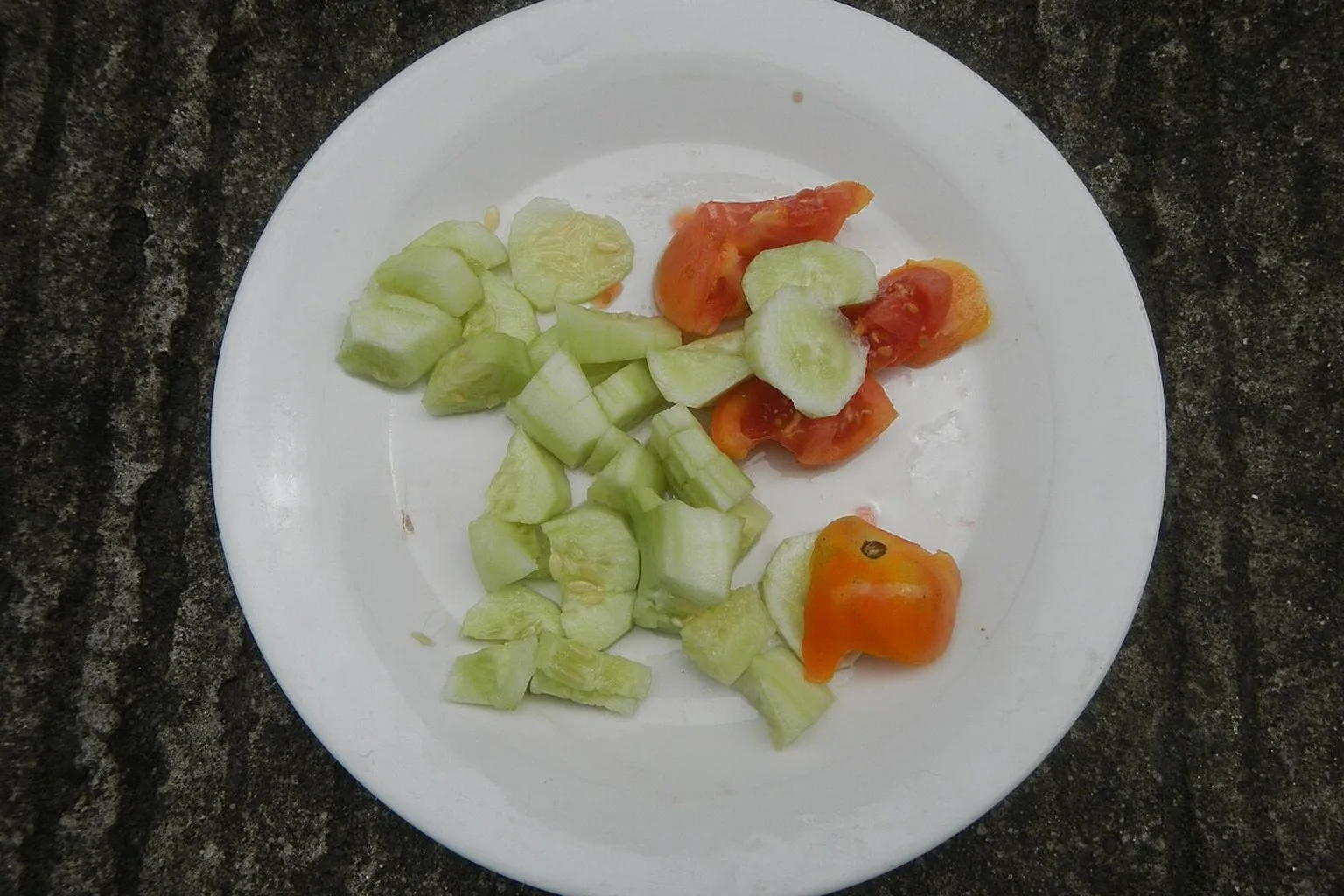
Can Rabbits Eat Cucumber? Water Content, Portions, and Peels
Cucumber is safe for rabbits in small pieces, but at roughly 96% water it stays a small extra. Portions by weight, plus peel, seeds, and leaves.
Diet & Nutrition
Can Rabbits Eat Mung Bean Sprouts? Portions, Washing, and Sprout Safety
Mung bean sprouts are on the House Rabbit Society safe list. How much to feed, why raw sprouts need cold storage and rinsing, and which sprout products to skip.
Diet & Nutrition
Can Rabbits Eat Persimmons? Ripe Fruit Only, Portions, and Tannins
Ripe persimmon flesh is a small rabbit treat: why unripe fruit is astringent, which varieties need to soften first, and how to keep fruit to treat size.
Diet & Nutrition
Can Rabbits Eat Spinach? Oxalates, Portions, and How Often
Spinach is safe for rabbits in a rotation, not a daily bowl: it is high in oxalates. Portions by weight, how often to offer it, and when to skip it.