The short answer
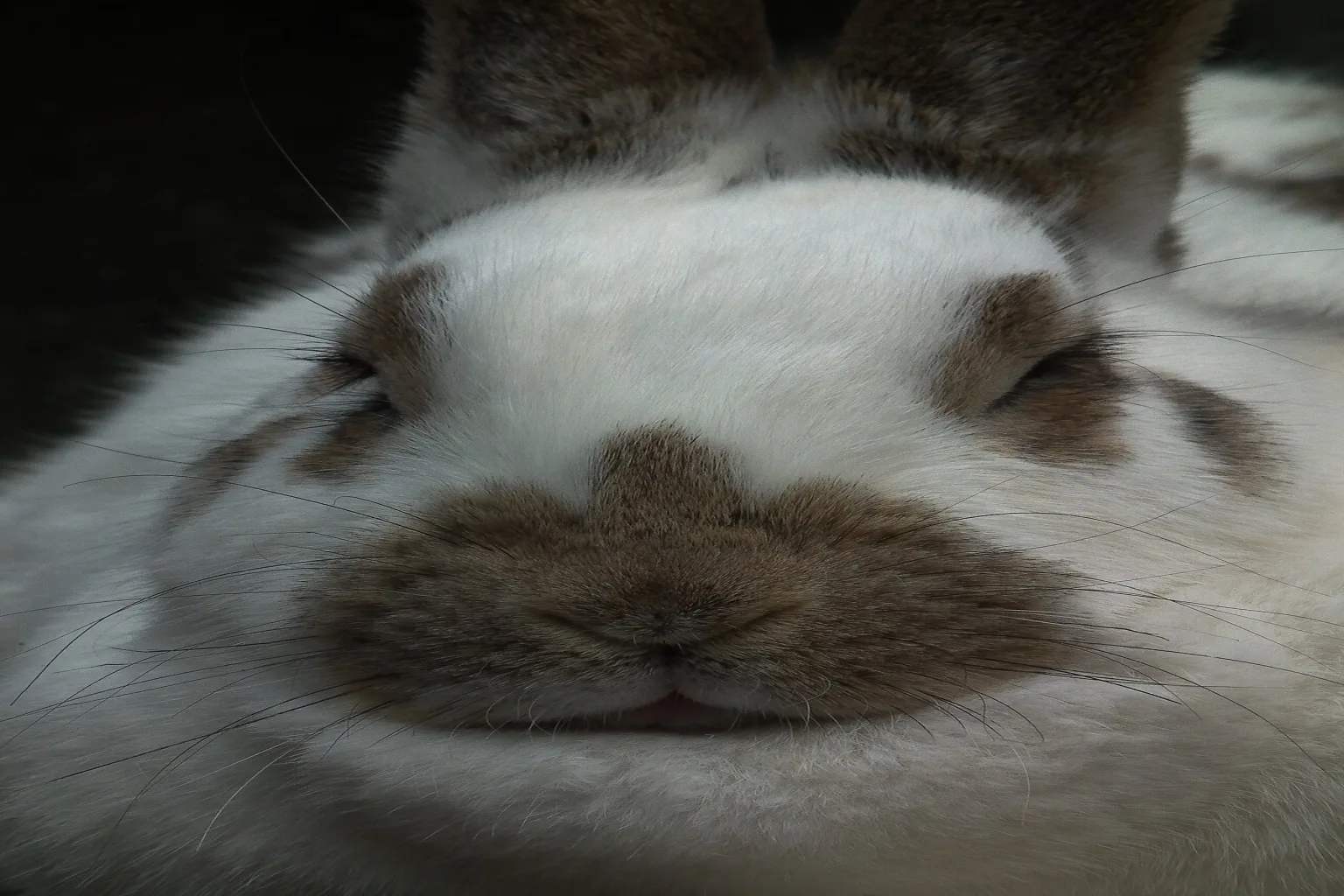
Some rabbits will turn towards a screen and follow movement on it, but there is no evidence that a rabbit watches television as entertainment, and the honest answer is that a screen is a bright moving light with sound attached. What a rabbit notices first is motion and noise, not plot. Because their hearing is far more sensitive than ours, a loud television is more likely to be a stressor than a treat, and the thing that reliably changes a rabbit's day is not content but space, structure and something to chew.
- What they notice: movement, brightness change and sound, across a field of view far wider than ours.
- What they cannot do: read a flat picture as a scene. Rabbit eyes are built for distance and motion, not for detail.
- What makes it a stressor: volume, especially deep bass and sudden noise, from a room the rabbit cannot leave.
- What they need instead: a hiding place within reach, hay to work through, a platform or tunnel, and rabbit company.
- How to try it: low volume, short session, the rabbit's own space and hiding place available the whole time.
What a rabbit actually sees on a screen
Rabbit eyes are the eyes of a prey animal, and the published description is specific. The House Rabbit Society's guide to the rabbit eye puts the field of vision at almost 360 degrees, with a small blind spot directly in front and another directly behind, long-sighted vision with limited close-up focus, and poorer depth perception than a person has. Colour vision is dichromatic: rabbits have two working colour receptors, so blue and green register and much of what we call red or orange does not. Cone density at peak is roughly 18,000 per square millimetre, about ten times fewer than a human, while rod density is around 300,000 per square millimetre, about twice a human's, which is why a rabbit sees well in dim light and why movement is what gives an object away.
Rabbits also sleep with their eyes open, and they use a head-swaying motion called parallaxing to judge distance. Put those facts together and a television is not a small window into another room. It is a flat surface that changes brightness many times a second.
The parts of a screen a rabbit registers
| Screen property | What rabbit vision is built for | What it means in the room |
|---|---|---|
| Colour | Dichromatic: blue and green only, about ten times fewer cones than a person | Colour-rich footage is not the draw it is for us; a rabbit is not following the picture as a picture |
| Detail | Long-sighted with limited near focus | Anything smaller than a moving shape across a room is mostly blur |
| Motion | Around twice the rod density of a human, wide field, motion-led attention | Movement and cuts are the part a rabbit notices |
| Depth | Poor depth perception, blind spot directly in front and behind | A flat image is not read as a space behind the glass |
| Brightness | Strong dim-light vision, limited pupil contraction | A bright flickering panel in a dark room is a bigger visual event for the rabbit than for you |
The practical consequence is that a rabbit staring at a screen is usually reacting to the movement, and a rabbit that ignores the screen is not missing anything.
Sound is the part to think about first
If there is one thing worth changing about a television in a room with a rabbit, it is the volume. The House Rabbit Society's guidance on loud holidays explains that rabbits are prey animals wired to be alert and ready to flee, that sudden loud noises startle them, and that very deep sounds are especially likely to. It recommends masking outside noise with soft music at low volume precisely because rabbits have very sensitive ears, and it recommends a hide box as a place to retreat to rather than picking a frightened rabbit up.
The volume rules that matter most
- Keep the volume low and keep the speakers away from the rabbit's pen or favourite resting spot.
- Watch the low end. Explosions, action soundtracks and heavy bass are the sounds most likely to send a rabbit to its hide.
- Give a choice. A cardboard box or covered hide within a hop of the rabbit lets it leave the room without leaving the room.
- Never trap a rabbit with the noise. A rabbit shut in a small pen with a loud screen has no way to act on its instinct except freeze.
- Turn it off if the rabbit reacts. Thumping, a tense crouch, ears flat back or a sudden refusal to eat are all answers.
If you want to try it: a calm ten minutes
There is no harm in finding out what your own rabbit does, provided the test is arranged so the rabbit is in control of it. Set it up like this:
- Start quiet. Volume just above audible, from across the room, with no bass-heavy content.
- Give the rabbit its normal space. Hay, water, litter box and a hiding place all stay where they always are.
- Ten minutes, then stop. Sit on the floor and watch the rabbit rather than the screen.
- Note what happened. Where did the rabbit settle? Did it look at the screen, flop, thump, freeze or carry on eating?
- Repeat the next day without the screen and compare. If the room is quieter and the rabbit is doing the same things, the screen is not adding anything.
How to read the answer
A rabbit that flops over and dozes while the television is on is a rabbit that is relaxed enough to ignore it, which is the best result this test can produce. A rabbit that freezes, thumps or hides has given you a cheaper answer than a vet bill would.What actually holds a rabbit's attention
The research on rabbit enrichment is about structure, not screens. A peer-reviewed study of group-housed growing rabbits published in Animals (MDPI) found that an elevated platform increased exploratory behaviour and stretched-out resting, while a plastic hiding tube was scarcely used and did not substantially change behaviour, and it notes that gnawing materials are the most commonly used rabbit enrichment, with a record of reducing stereotyped behaviours such as cage-bar biting. In other words, the things that move a rabbit's behaviour are things it can climb, chew, enter and control.
That matches the practical guidance from the welfare bodies: rabbits need hiding places, things to chew, space to move and, ideally, rabbit company. A screen supplies none of that, and a rabbit left alone with a loud television has not been given company. If the reason for turning the television on is that the rabbit seems bored, the answer is a better pen, not more channels.
What to add to the pen instead
- Forage instead of watch. Hay packed into a plain cardboard tube keeps a rabbit busy for longer than any programme. The foraging and enrichment guide has the simple versions.
- Add a level. A stable platform or a low box to hop onto is the kind of change the study above associates with more movement and more relaxed resting.
- Rotate, do not pile up. Swapping two or three items each week works better than filling the pen with everything at once.
- Read boredom as information. Bar biting, digging at the floor and over-focus on food are design problems; the boredom guide covers the fixes.
If the rabbit is spending most of the day still and quiet, that is worth more attention than any screen test. The body language basics and the not eating guide both cover the quiet behaviours that are actually illness rather than boredom.
How to read your rabbit's answer
Rabbit body language is the real test, and the House Rabbit Society's behaviour vocabulary is a good place to learn it. It describes ears forward as the attention position, often called the antenna position, ears back as either dislike of what you are doing or simply a rabbit resting its radar, flopping as total relaxation, and tooth grinding in a relaxed rabbit as contentment, distinct from the rarer tooth chattering that signals pain.
| What you see | What it usually means | What to do |
|---|---|---|
| Ears forward and up, head turned towards the screen | Something has caught its attention, which is the closest thing to watching television a rabbit does | Nothing; note it and keep the volume where it is |
| Flopped on one side, or loafing with ears at rest and eyes half closed | Relaxed and settled, screen or no screen | Leave it alone; the rabbit is comfortable |
| Ears flat back with a tense, crouched posture | Displeasure, fear or pain; context decides which | Turn the sound down or off and check the rabbit properly |
| Thumping a hind foot | An alarm signal aimed at the room, not at you | Lower the volume and look for what else changed |
| Freezing in place and refusing food | A fear response, and a welfare problem rather than a preference | End the session, give space, and watch appetite and droppings for the rest of the day |
| Turning away to eat hay or work on a toy | The rabbit has chosen something more interesting | That is the answer: the screen is not enrichment |
| Teeth chattering with a hunched posture | Pain, not the contentment grinding | Contact a rabbit-savvy vet rather than treating it as a mood |
References and further reading
- Rabbit.org (House Rabbit Society): the rabbit eye: the almost 360 degree field of vision, the blind spots in front and behind, long-sightedness with limited near vision, dichromatic colour vision, cone and rod densities, and parallaxing.
- Rabbit.org (House Rabbit Society): keeping your bunny calm during loud holidays: prey-animal alertness, startle responses to sudden and deep noise, very sensitive ears, masking with soft low music, and the value of a hide box.
- Rabbit.org (House Rabbit Society): reading your rabbit's behaviour: ears forward as the attention position, ears back in context, flopping as relaxation, and the difference between contentment tooth grinding and pain.
- Trocino and others, Animals 9(8):537 (2019), the use of environmental enrichments and the behaviour of growing rabbits: elevated platforms and exploration, the limited use of a hiding tube, and gnawing materials in rabbit enrichment.
Related resources
Behavior & Bonding
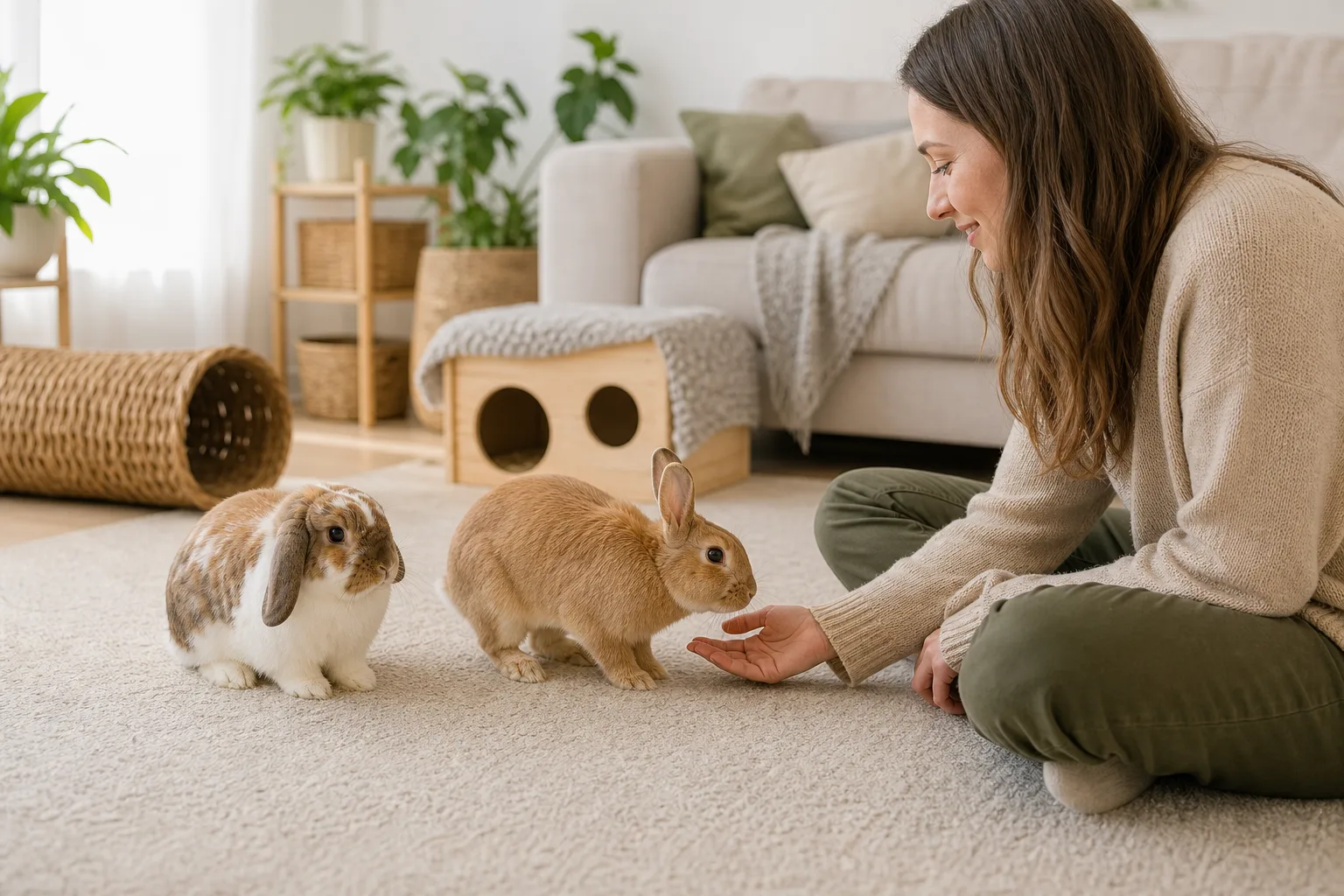
Bonding With Your Rabbit: Build Trust Without Forcing Cuddles
Learn quiet routines, floor-level interaction, treat timing, consent signals, and realistic expectations for affectionate rabbits.
Behavior & Bonding
Rabbit Body Language Basics: Binkies, Loafs, Thumps, and Trust
Read common rabbit signals so you can tell relaxation, curiosity, fear, irritation, and possible pain apart.
Behavior & Bonding
Rabbit Body Language With Pictures: 11 Real Photos Decoded
Real licensed photos of rabbit loafing, flopping, periscoping, grooming, and bonding, each decoded with the exact signal it shows.

Behavior & Bonding
Adopting Two Rabbits: Companionship, Bonding, and Practical Prep
Decide whether a bonded pair fits your home, budget, space, and care routine before adoption day.