The short answer
Enrichment is the answer to one question: what is this rabbit going to do all day? The Rabbit Welfare Association & Fund puts a number on it — in the wild, rabbits would spend 80% of their waking time foraging — and that figure explains most enrichment decisions that follow. A rabbit with a bowl of nuggets, a hutch, and nothing to work at is fed but not occupied.
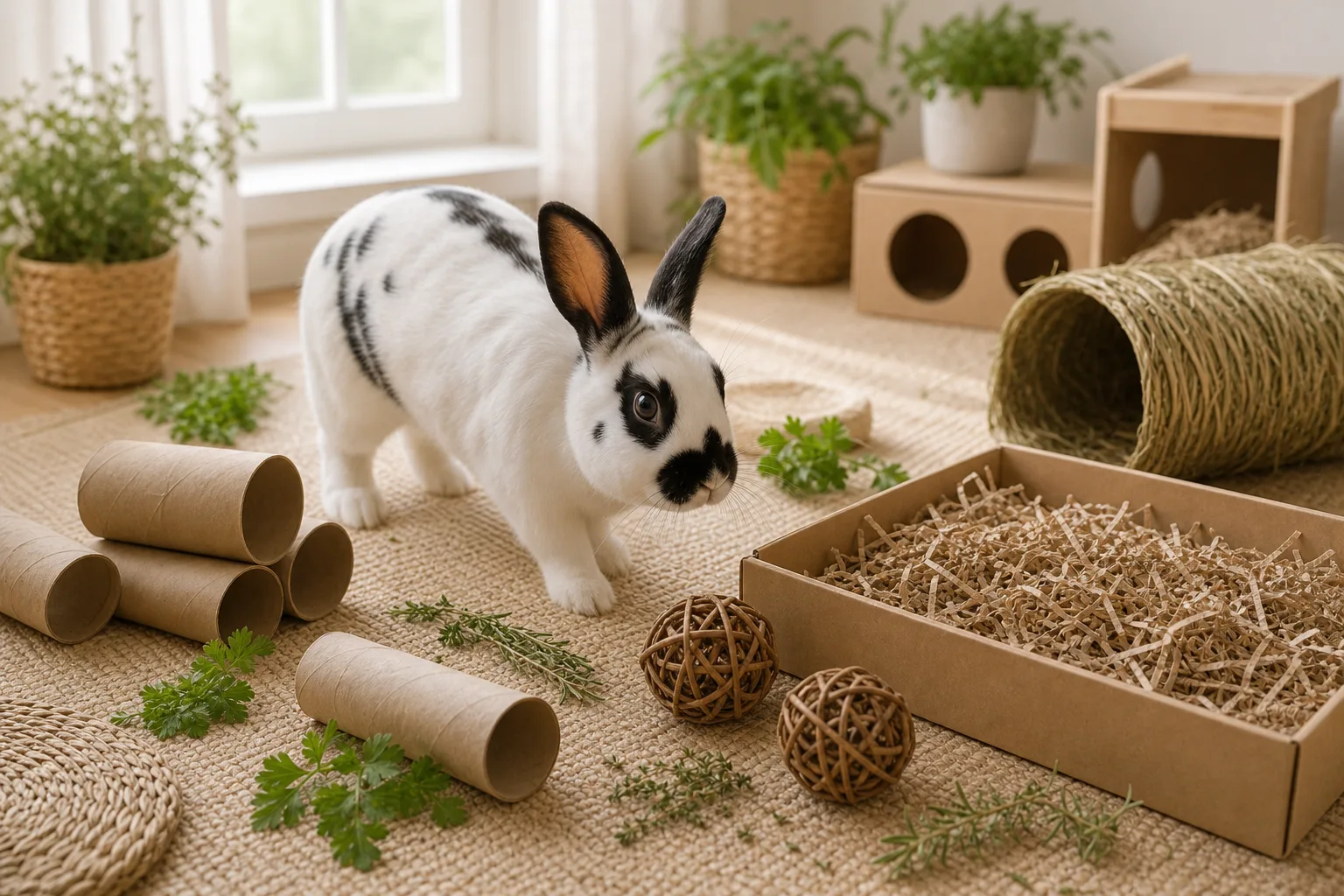
- Start with what you already own. The House Rabbit Society's guidance is that enrichment "can easily be made at home using items you likely already have on hand": a tissue box, toilet-roll and paper-towel tubes, a shallow box, and hay.
- The point is natural behaviour, not novelty. HRS says the best enrichment toys encourage a rabbit's natural behaviours — digging, chewing, foraging — and that the key is variety.
- It is also self-interest. Rabbit.org notes that toys protect your belongings by providing acceptable outlets for chewing, digging, burrowing and shredding.
- Rotate rather than accumulate. Both the RWAF and Rabbit.org ask owners to swap items on a schedule instead of buying more.
This guide covers the five behaviours worth building around, the household builds that work, the rotation that keeps them interesting, the limits on how much to add, and the materials that should stay out of the enclosure.
What enrichment actually is
The RWAF's definition is behavioural, not commercial. Wild rabbits would spend their time digging, running, jumping, rearing up, hiding, eating and socialising, so "to allow your pet rabbits to carry out their natural behaviours they need to be given plenty to do. We call this enrichment." Because wild rabbits spend most of their waking hours foraging, most pet enrichment revolves around hay and grass.
Rabbit.org widens the case beyond boredom: play gives "a sense of accomplishment and intellectual stimulation", and while physical needs are obvious, "emotional, intellectual, and social dimensions can have a greater impact on wellness than purely physical dimensions" — rabbit health can decline from emotional impoverishment. The RSPCA frames it from the animal's side of the bars: pet rabbits "spend most of their lives in their enclosures", so places to hide, toys to play with, food to forage, and space to be with companions or alone are "vital for their health and wellbeing". None of that needs a budget. It needs an hour of setup and a five-minute weekly shuffle.
The five behaviours to build around
Build the enclosure against the behaviours rather than shopping by product category. Each row below is published guidance from a rabbit welfare organisation.
| Behaviour | What it looks like | What serves it | Source |
|---|---|---|---|
| Foraging | Nosing through hay, working pellets out of a tube or tray, searching hidden greens | Hay and grass as the base, plus a treat ball, stuffed tubes, a muffin tray, scattered rations | RWAF |
| Digging | Scraping, scattering, pushing filler aside | A digging pit or box — a large tray or planter of earth, or a shallow box of paper, hay or play sand | RWAF, Rabbit.org |
| Chewing | Working through branches, boxes and tubes | Willow, hazel, apple and blackthorn branches; plain cardboard; hay | RWAF, Rabbit.org |
| Hiding and tunnelling | Entering, exiting and retreating; watching from cover | A tunnel with a hole at each end, plus hides and boxes placed so the rabbit can withdraw | RWAF, RSPCA |
| Rearing up and scanning | Standing on the hind legs to look over the space | A platform — a block of wood or a sturdy box — inside an enclosure tall enough for a full stretch | RWAF |
Two rows carry a number worth remembering. The RWAF says rabbits need at least 1 metre (just over 3 feet) of height so they can stretch up, because a rabbit that cannot rear fully risks a painful spinal deformity. And a tunnel needs a hole at each end, because rabbits are prey animals: they must know they have both an entrance and an exit, or they will simply stay away from it.
Foraging games from household materials
Every item below is published guidance, and every one is built from packaging that would otherwise go in the bin. The RWAF's position is blunt: rather than put food in a bowl, put it around the enclosure, in tunnels or under hay, which encourages the natural urge to forage.
| Game | What you need | What it works | Source |
|---|---|---|---|
| Hay-stuffed cardboard tube | A toilet-roll or paper-towel tube packed with hay, with herbs mixed through | Foraging, chewing, food-searching | RWAF, Rabbit.org |
| Hay-stuffed tissue box | A tissue box with the plastic film removed, stuffed with hay and a light sprinkle of pellets or an herbal blend | Foraging, shredding | House Rabbit Society |
| Tube-and-box puzzle | The top cut off a tissue box, five or six toilet-roll tubes standing side by side inside, treats sprinkled over the openings | Problem-solving, pushing, pulling | House Rabbit Society |
| Wrapped tossable | A tube unravelled at its seam and wrapped back around a bundle of hay | Tossing, chewing, carrying | House Rabbit Society |
| Tucked-end roll | A roll filled with an herbal blend, pellets or a treat, ends loosely folded in | Pushing, nosing, working for food | House Rabbit Society |
| Muffin-tray puzzle | An old muffin or Yorkshire pudding tray, each hole filled with hay and hiding a pellet or small treat | Foraging, nose-work | RWAF |
| Paper-bag forage | A plain paper bag stuffed with hay and herbs | Wrestling, shredding, foraging | RWAF |
| Treat ball | A treat ball loaded with the daily nugget ration | Nosing the ball around, movement, portion control | RWAF |
| Scatter feeding and hidden greens | The nugget ration sprinkled through hay or grass; leafy greens tucked into boxes and corners in different places each day | Searching, slower eating, exploration | RWAF |
| Turf tray | A litter or potting tray of turf from a garden centre — ideally two, swapped so the grass regrows | Grazing, fresh grass without a lawn | RWAF |
| Natural branch | Willow, hazel, apple or blackthorn | Chewing, stripping bark | RWAF |
| Fleece and baby toys | A yard of fleece to push and dig at; plastic baby toss toys and stacking cups | Pushing, digging, tossing | Rabbit.org |
One caution belongs at the top of this table rather than underneath it: the food that goes inside a puzzle must come out of the ration, not on top of it. Pellets and treats hidden in a tray still count against the day's small measured allowance — the same discipline that keeps the daily plate hay-first.
Building a dig box that works
A dig box is the build that most reliably converts destructive digging into something you can live with. The RWAF's instruction is that rabbits not kept on grass "will need a digging pit" — a large litter tray or planter filled with earth, changed regularly. Rabbit.org recommends a digging box filled with paper, play sand or hay. The House Rabbit Society adds the indoor version: a shallow box large enough to dig and forage in, filled with obstacles and a scatter of food.
| Filler or obstacle | Published guidance | Before you use it |
|---|---|---|
| Plain soil or earth in a tray or planter | RWAF: the standard digging pit for rabbits not kept on grass | Change it regularly; if the rabbit is on grass instead, ensure it cannot dig out |
| Crumpled packing paper | House Rabbit Society: a perfect dig-box obstacle | Supervise the first session; remove tape and staples |
| Newspaper or phone-book pages | House Rabbit Society: acceptable when the ink is soy-based | Glossy or laminated paper is not a substitute |
| Hay | Rabbit.org lists hay as a dig-box filler | Replace any that becomes soiled; keep it edible |
| Play sand | Rabbit.org lists play sand as a dig-box filler | Keep it dry and covered when not in use |
| Scattered pellets, herbs or treats | The House Rabbit Society sprinkles these in with the hay | Take them out of the daily ration |
| Cat litter, coloured craft filler, painted or glued material | Not supported by any source here | Do not use; a rabbit ingests a little of whatever it digs in |
The House Rabbit Society publishes the failure mode too, and it is worth repeating: if the rabbit turns out to be more interested in eating the cardboard or paper than the hay and food inside, that material is the wrong choice for that rabbit and a different item is the better answer. Cardboard eaten as a meal is displacement, not enrichment.
Tunnels, hides, and platforms
Each structure below has a rule attached that is easy to get wrong. Get the tunnel rule wrong and the rabbit simply never uses it.
| Element | The rule, as published | Why it matters |
|---|---|---|
| Tunnel | A hole at each end | RWAF: rabbits are prey animals, so they need to know they have both an entrance and an exit; without one at each end they stay away |
| Tunnel and hide count | Enough for every rabbit | RSPCA: with several rabbits, make sure there are enough items for each animal so they do not compete |
| Hide placement | Available and reachable | RSPCA: rabbits must be able to move away, hide from new items, and retreat from social contact if they choose |
| Platform | A block of wood or a sturdy box to stand on | RWAF: rabbits are prey animals and like to check their surroundings, so give them something to look out from |
| Height | At least 1 metre (just over 3 feet) of enclosure height | RWAF: this allows a full stretch upward and avoids a painful spinal deformity |
| Home base | Keep the main sleeping place and the tunnels where they are | RWAF: rabbits need to know their home base is secure and safe when other things move |
Tunnels do not have to be bought. The RWAF's own suggestion is a cardboard box with a hole cut at each end, which doubles as a platform when the rabbit climbs on top — and which the rabbits will eventually demolish and need replacing. That demolition is the enrichment working, not a failure.
The rotation system that stops boredom
Every source agrees on rotation and none of them agree on buying. The RWAF asks owners to "switch toys and furniture around every now and again" so rabbits do not get bored; Rabbit.org asks for new toys monthly and regular rotation. Rotation works because novelty is the active ingredient: an ignored object that disappears for two weeks comes back interesting.
| Week | Foraging | Dig or chew | Move or hide |
|---|---|---|---|
| 1 | Scatter feed in the hay plus one stuffed tube | Paper dig box in the usual spot | Rotate the tunnel out; leave one hide in place |
| 2 | Muffin-tray puzzle with hay and a few pellets | Fresh willow or apple branch | Move the platform to a new corner |
| 3 | Paper-bag forage plus hidden greens | Swap in the second turf tray | Add a new cardboard box as a hide |
| 4 | Treat ball with part of the ration; the old tubes come back | Hay the old tube back into service | Rearrange the toys, leave the sleeping place and tunnel alone |
Two fixed points keep the system safe. The sleeping area and the main tunnel stay put — the RWAF is explicit that the home base must feel secure while everything else moves. And rotation must never reduce hay: if a game starts costing hay intake it is doing more harm than good, which is the same reason a bored rabbit's fix is never one expensive toy.
There are two published limits on how much to add. The RSPCA warns against filling a rabbit's space with so many items that it cannot exercise easily, because rabbits need to run, jump, stand fully upright and hop — enrichment should encourage that movement, not block it. And where several rabbits share a space there must be enough items for each, so nobody has to compete. Place the food work where the rabbit already spends time, leave the quiet corners quiet, and prefer a few rotated items over a crowded pen of untouched plastic.
Safety: what to avoid and why
Enrichment that can be eaten is a different risk class from enrichment that can be pushed around, and both the RSPCA and the House Rabbit Society publish specific cautions.
| Item or habit | The risk | What to do instead | Source |
|---|---|---|---|
| Fabrics — towels, blankets, vetbeds, rugs, carpets | Harmful if the rabbit eats them | Only while you supervise the whole time | RSPCA |
| Cardboard or paper with tape, staples, glue or heavy print | Toxins and adhesives can be swallowed | Remove film, tape and staples; soy-based ink pages only | House Rabbit Society |
| A rabbit that eats the cardboard instead of the food | The game becomes an ingestion risk | Switch to a different enrichment item for that rabbit | House Rabbit Society |
| Treated, painted or unidentified wood | Potential toxicity | Stick to the RWAF's woods: willow, hazel, apple, blackthorn | RWAF |
| A new item dropped in without warning | Stress or fright in a prey animal | Introduce for short periods, watch the rabbit, remove the item if needed | RSPCA |
| Metal household parts used as toys | Rust and sharp edges | Check for rust and sharp edges, and supervise the first session | House Rabbit Society |
| Food puzzles that reduce hay eating | Diet and gut risk in a hay-first species | Keep hay as the base; count puzzle food against the ration | RWAF, RSPCA |
The RSPCA adds a routine warning that is easy to skip: rabbits need a predictable routine, so if they are used to a toy or object at the same time each day, keep that going, because the disruption itself is a stressor. Enrichment is meant to lower stress, not add to it.
Common mistakes
- Buying toys but never rotating them. Every source here asks for rotation; an unchanged pen is the most common way a good setup goes stale.
- Filling the space. The RSPCA's instruction is the opposite of a crowded pen: leave room to run, jump and rear up.
- One of everything in a multi-rabbit home. Competition over a single tunnel creates the tension enrichment is meant to relieve.
- Using food puzzles that cut hay intake. That trades a diet problem for a boredom problem.
- Treating destructive chewing as a discipline problem. Rabbit.org's framing is that toys exist to redirect chewing, digging and shredding into acceptable outlets; if the damage continues, change the outlet. See fixing unsafe chewing.
Matching enrichment to the rabbit in front of you
The same four materials — hay, cardboard, a tray and something to climb on — arrange themselves differently for different rabbits.
- A shy or newly adopted rabbit: lead with hiding places and cover, because the ability to retreat is what makes a nervous rabbit willing to explore at all. Pair it with the new owner checklist and the daily routine rather than adding novelty quickly.
- A young or high-energy rabbit: lead with tunnels, a dig box and floor time. A tunnel with an exit at each end is the structure that gets used most, and the floor-time plan is where running and jumping belong.
- A rabbit in a small indoor setup: the platform and the 1-metre stretch rule do the most work per square centimetre; check the space standard before adding objects.
- A single rabbit: the RWAF notes that rabbits with companions forage more because they are less stressed, so a lone rabbit needs more of the owner's time and more foraging work. See bonding and adopting two.
- A rabbit that wrecks the room: read it as a signal and rebuild the environment — the bunny-proofing guide and boredom fixes cover the two usual causes.
Once the basics run, the quickest way to keep them fresh is to generate a new combination rather than shop: the enrichment idea generator and the enrichment challenges both exist for that, and the care checklist confirms the daily hay, water and observation habits are still intact underneath the games.
References and further reading
Every figure and rule above comes from the following published sources, read directly:
- Rabbit Welfare Association & Fund — Rabbit Housing Enrichment: the 80% foraging figure, tunnels with a hole at each end, the digging pit, platforms, the 1-metre height rule, toy rotation, and the foraging materials list.
- RWAF — Foraging: what foraging covers, why it matters, and the three levers (companionship, diet, environment).
- House Rabbit Society — Homemade Enrichment Ideas (Shanleigh Knittel, HRS Licensed Educator, House Rabbit Journal, Fall 2023): the tissue-box and tube builds, the dig-box instructions, the non-paper tossable, and the cardboard-eating caution.
- RSPCA — Enrichment for rabbits: hiding places, platforms and toys; the crowding limit; the fabric warning; the routine requirement; and the introduce-and-watch rule.
- Rabbit.org — Why Rabbit Toys Are Crucial: toys as protection for your belongings, emotional and intellectual enrichment, and monthly rotation.
Related resources
Enrichment & Play
Rabbit Boredom Signs and Simple Enrichment Fixes
Spot boredom patterns like bar biting, destructive digging, over-focus on food, and low exploration, then improve the day.

Behavior & Bonding
Do Rabbits Like to Watch TV? What a Rabbit Sees and Hears
What rabbit vision and hearing actually pick up from a screen, why a loud television can be a stressor, and what genuinely holds a rabbit's attention.
Housing & Bunny-Proofing
How to Plan Safe Floor Time for Indoor Rabbits
Make exercise time safer with room checks, barriers, traction, timing, supervision, and enrichment stations.
Behavior & Bonding
Bonding With Your Rabbit: Build Trust Without Forcing Cuddles
Learn quiet routines, floor-level interaction, treat timing, consent signals, and realistic expectations for affectionate rabbits.