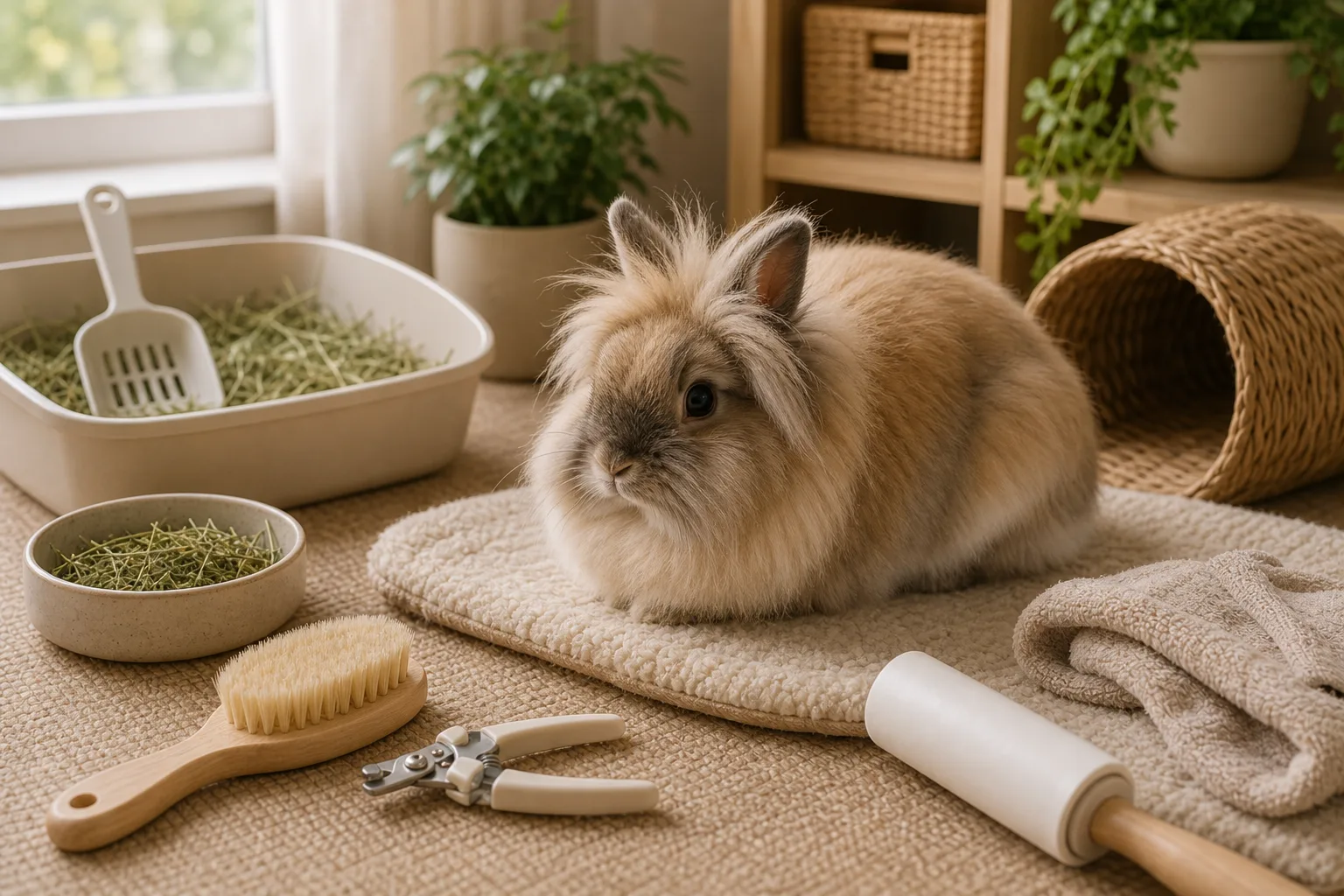
The short answer
Cleaning has two speeds, and the welfare organisations agree on both. The RSPCA says a rabbit’s home should be thoroughly cleaned around once a week, with toilet areas cleaned every day. PDSA splits it the same way, and Blue Cross supplies the reason it is a health job rather than a housekeeping one: flies lay eggs on soiled bedding, and the maggots that hatch burrow into the rabbit.
- Daily: lift wet litter and soiled bedding, refresh hay and greens, rinse the bowls.
- Weekly: empty the enclosure, scrub it with a pet-safe cleaner, dry it completely before the rabbit returns.
- More rabbits, more often. The RSPCA: the more rabbits share an enclosure, the more often it needs cleaning out.
- Cleaner, not sterile. Keep some unsoiled bedding back so the enclosure still smells like home — the RSPCA and Blue Cross both recommend it.
- Routine disinfection is not required. The RWAF: good hygiene is usually all that is needed, and repeated disinfectant exposure can irritate a rabbit’s respiratory lining.
How often: what the guidance says
Four welfare organisations publish overlapping guidance. The differences track rabbit density and bedding type, not disagreement.
| Source | Toilet area | Whole enclosure |
|---|---|---|
| RSPCA | Clean every day | Thorough clean around once a week; more often if the rabbits soil the space, and the more rabbits share it |
| PDSA | Daily: remove wet or dirty bedding, bin uneaten greens and pellets, replace with fresh | Deep clean weekly: take everything out, scrub with pet-safe cleaner, dry completely before bedding goes back |
| Blue Cross | Check bedding every day and remove anything soiled, especially in hot weather | Deep clean periodically; disinfect and air until completely dry |
| House Rabbit Society | Change the litter box every other day; dump the whole box every 2–3 days or when the pellets stop rattling | Paper-lined boxes without absorbent litter need daily changing; litter-lined boxes last two days or more |
Read that as a floor, not a ceiling: a large pen with one rabbit sits comfortably at the weekly clean, while a compact setup with two rabbits — or any enclosure in warm weather — pushes toward daily. The enclosure size checker gives the space figure that makes a weekly clean realistic.
What the smell actually is
Rabbit urine breaks down into ammonia, and ammonia is what does the harm. The House Rabbit Society names it as the reason to avoid any litter box with a grate or wire-mesh floor: waste collects underneath, and what builds there is an ammonia pocket the rabbit sits above.
| What builds up | What it causes | What prevents it |
|---|---|---|
| Ammonia in litter and bedding | Respiratory irritation; the RSPCA lists dirty environments among conditions that cause suffering and illness | Daily removal of wet litter (RSPCA, PDSA) and no grate or mesh floors (HRS) |
| Urine staining and stuck droppings | Attracts flies; the RSPCA calls flystrike “often fatal” and asks for rear-end checks twice a day in warm weather | Regular cleaning of toilet areas and removal of soiled bedding (RSPCA); under-tail checks at least daily (PDSA) |
| Soiled bedding in warm weather | Flies lay eggs on the rabbit and the maggots burrow into fur and body — Blue Cross calls fly strike fatal | Daily bedding checks with soiled material removed, especially in hot weather (Blue Cross) |
A better test than your nose: the RSPCA lists a clean and dry bottom and tail among the signs of a healthy rabbit, so a rabbit needing a wipe after a clean enclosure means the tray is going too long. Heat sharpens all of it (summer cooling).
The daily reset
The daily job takes five minutes and needs no dismantling: the RSPCA and PDSA both describe removing what is soiled and replacing what is eaten, not a wash-down.
| Task | What to do | Source |
|---|---|---|
| Toilet area | Empty wet litter and droppings | RSPCA |
| Food | Bin uneaten greens and left-over pellets, replace with fresh | PDSA |
| Bowls and bottle | Clean with soapy water, pet-safe cleaner or the dishwasher, then rinse and dry before refilling; a water bowl may itself become soiled | PDSA |
| Bedding | Remove anything soiled — check every day, especially in hot weather | Blue Cross |
| Hay | Top up hay and racks; uneaten hay is not hay eaten (see choosing hay) | RWAF |
| The rabbit | Check the rear end and tail — twice daily in warm weather | RSPCA |
Keep it targeted: stripping everything out daily is more work than the guidance asks for and costs the rabbit its familiar scent. The structured version is the rabbit care calendar, summarised on the rabbit care checklist.
The weekly deep clean
Blue Cross publishes the most detailed sequence, arranged around not upsetting the rabbit. Follow it in order.
- Move the rabbit first. Wait until your rabbit is in the run, or place them in a carrier with some of their bedding.
- Set unsoiled bedding aside to put back at the end, so the enclosure smells familiar — Blue Cross and the RSPCA both recommend this.
- Roll up the base layer. Grab the underlying newspaper and roll it up with the soiled bedding inside, so waste leaves in one parcel.
- Clean the exercise area too — the run needs the same treatment as the sleeping area.
- Scrub with a pet-safe product. PDSA says scrub with pet-safe cleaner; for deep disinfecting, Blue Cross suggests a pet-safe disinfectant sprayed throughout the hutch, including the front bars.
- Dry completely. The step people skip: the RSPCA requires the housing be dry before the rabbits go back, PDSA that everything be completely dry before bedding returns, Blue Cross that it air until completely dry.
- Rebuild from the bottom: newspaper lining, bedding on top, then the saved unsoiled bedding.
The RSPCA adds one structural rule: keep sleeping, food and toilet areas separate, with the tray outside the sleeping area; PDSA suggests the same. If your tray sits beside the hay rack, setting up the litter box covers placement.
What to clean with
Two rules decide almost every product choice. The RSPCA says to use only non-toxic products or natural DIY cleaners, because a rabbit will lick surfaces you have just washed; for the deeper clean, the RWAF’s position is that cleanliness does the work and disinfection is an optional second stage.
| Product | What the sources say |
|---|---|
| Non-toxic or natural cleaners | The RSPCA’s baseline; dry the housing before the rabbits return |
| Vinegar and water | The HRS’s recommendation for urine outside the tray, with the warning that soap and water alone is not sufficient to remove all chemical traces of urine even when the surface looks clean |
| Pet-safe enzymatic cleanser | Also from the HRS, for removing the scent marker rather than the stain |
| Pet-safe disinfectant | Blue Cross: spray everywhere in the hutch including the front bars, then air until completely dry |
| Bleach | The RWAF: effective, cheap and fast, but the housing “may also need to be left to air dry in a well ventilated space for up to 24 hours” before rabbits return |
| Virkon S or Anigene HLD4V | The RWAF: longer contact times but much less toxic, so rabbits can be rehoused once the accommodation is dry |
Four RWAF rules decide whether a disinfectant works at all: clean first, because some products are inactivated by faeces, urine, blood and food debris; respect the full contact time, then rinse with plenty of water; use the manufacturer’s dilution, since stronger is dangerous and weaker ineffective; and never mix a disinfectant with household chemicals or another, as the combination can release harmful gases.
Litter tray hygiene
The tray is where the smell originates, so the lining choice matters more than the technique. The HRS describes three ways to fill a box, with different lifetimes.
| Fill | How it is built | Change rate |
|---|---|---|
| Newspaper and hay | About eight single sheets of newspaper under a three-inch layer of hay or straw | Daily — a paper-lined box with no absorbent litter underneath needs changing every day |
| Litter and hay | One to two inches of litter under two to three inches of hay | Two days or more |
| Litter or shredded paper alone | Used on its own, with a treat or toy added in one corner | The HRS suggests this during hay shortages, when hay is needed for eating |
On the litter itself the HRS is specific: safe materials are paper fibre, mountain grasses, wheat and specially processed woods with reduced phenols. Compressed paper or wood-pulp pellets give excellent odour control with low dust, and wheat- or grass-based litters are gentle on paws, whereas clay or clumping cat litter is dangerous if ingested, pine and cedar shavings carry aromatic oils that can irritate the respiratory system and liver, and corn cob or walnut shell litter moulds and absorbs poorly. The RWAF puts clumping cat litter and sawdust on the same avoid list.
The HRS recommends plastic trays — lightweight, easy to disinfect, they do not absorb odour — warns against metal or wire bottoms that hurt the feet and contribute to sore hocks, and rejects any box with a grate because trapped waste causes ammonia build-up. Blue Cross suggests a rabbit-friendly litter such as Megazorb or Aubiose under newspaper. For behaviour, see litter training and the accident triage guide.
Bedding and flooring choices
Bedding is the choice owners get wrong in both directions: too little absorbency, or absorbent but irritating. The RWAF’s material-by-material assessment is simple — absorbent and dust-extracted is good, aromatic and dusty is not.
| Material | RWAF assessment |
|---|---|
| Soft straw | Recommended as ideal bedding for warmth and comfort, especially outdoors: hollow strands trap warm air, and it is absorbent. Straw is dried stalks, not hay — hay is the food. |
| Wood-based cat litter pellets | Heat-processed, which removes the harmful oils and phenols, so no skin or lung irritation risk. Use under straw for sleeping areas. Read the label: at least one brand contains silicon. |
| Pulped paper (e.g. Megazorb) | Safe, highly absorbent, dust-extracted, and a paper-industry waste product. |
| Paper pellets | Highly absorbent and suited to litter areas, but less comfortable as bedding — cover with something softer. |
| Shredded paper | Quality varies with the paper shredded; softer is better. Printed paper raises the question of ink if the rabbit ingests it. |
| Newspaper | Common for lining sleeping and litter areas for absorbency and insulation, but inked — cover with straw. |
| Aubiose and Miscanthus | Hemp/flax and elephant grass: natural, biodegradable, highly absorbent alternatives to straw. |
| Sawdust | Advise against: it irritates skin and lungs through the wood’s oils and phenols, which can be absorbed and cause low-grade liver inflammation. |
| Wood shavings | Effectively sawdust in larger pieces, so lower risk, but still to be used with care and only in a well-ventilated environment. The RWAF notes it revised this position after enquiring how good-quality shavings are produced. |
| Clumping clay cat litter | Advise against: it clumps in the gut if ingested and causes serious problems. |
On flooring, Blue Cross makes one time-saving point: lino or vinyl is easy to clean and useful for lining wooden shelters, but the rabbit still needs bedding on top. The RWAF’s standard applies to any substrate — plenty of airspace and good airflow, cleaned regularly, with the rabbit free to leave the sheltered area for exercise. Bedding interacts with coat type too (shedding guide).
Bowls, bottles, toys and hides
A bowl can look clean and still hold a film. PDSA’s daily list covers it — wash bowls in soapy water, a pet-safe cleaner or the dishwasher, then rinse and dry before refilling; a water bowl may itself become soiled.
- Hay racks and bottle clips. The RWAF lists these among the surfaces needing attention when disinfecting, because they are handled and are not removed for washing.
- Toys, chews, hides. Wash and rotate rather than replace, and inspect rope- and wood-based items for wear; cardboard hides are disposable by design. See the enrichment guide.
Indoor and outdoor enclosures
Indoor and outdoor setups fail differently, so the routine should differ too.
| Setting | What goes wrong | What to do |
|---|---|---|
| Indoor pen or room | Damp, poorly ventilated or draughty conditions; the RSPCA groups these with dirty environments as causes of suffering and illness | Ventilate the room, keep the enclosure away from draughts and radiators, and remove wet litter daily |
| Outdoor hutch or shed | A base on the ground becomes damp and rots; the RSPCA warns wet bedding freezes on cold nights and can make a rabbit ill | Raise the home at least 10 cm (4 inches) off the ground, keep it waterproof and draught-proof, and check bedding before cold nights |
| Wooden housing | The RWAF: wooden hutches are hard to clean effectively because cracks and crevices collect contagious material | Clean as thoroughly as possible before disinfecting, then wet every surface and corner; steam cleaning reaches awkward areas first |
| Run or exercise area | It gets treated as a lower-priority space | Clean it in the same pass; the RSPCA also asks that hiding places outnumber the rabbits by one |
Winter raises the stakes: the RSPCA notes rabbits spend longer in their hutch during the winter months. The setup side — space, flooring, layout — is covered in indoor housing setup.
Keeping the rabbit calm while you clean
The RSPCA: “Cleaning can be stressful for rabbits as it disrupts their familiar routines” — its fix is to put a small amount of the used bedding back so there is a familiar smell to return to, and Blue Cross builds the same idea into its sequence.
- Clean around the rabbit where you can. With larger housing you can clean while they eat or play, rather than moving them at all.
- Use a carrier, not a chase. If the rabbit must come out, use a carrier with some of their bedding.
- Read the response. A rabbit that thumps, freezes or hides afterwards is telling you the disruption was too complete; see body language basics.
When cleaning is not enough
Cleaning addresses the environment, not a rabbit that cannot keep itself clean. That distinction decides whether you clean harder or call a vet.
- Persistent staining despite cleaning. The RSPCA notes rabbits with arthritis often struggle to keep their bottom clean, and that an elderly rabbit may need a litter tray with lower sides.
- Any sign of flystrike. Flies lay eggs that hatch into maggots burrowing into fur and body (Blue Cross); the RSPCA calls it often fatal and asks for twice-daily rear-end checks in warm weather — a same-day vet problem (see the warning signs guide).
- Smell returning within a day of a full clean. That points at absorbency: too little litter, a non-absorbent base, or a tray too small. The HRS recommends a box at least double the rabbit’s size.
- Contagious disease in the household. The RWAF names myxomatosis, rabbit viral haemorrhagic disease strains 1 and 2, and Encephalitozoon cuniculi, and reports that 0.1% bleach with a 10-minute contact time, or 70% ethanol with a 30-second contact time, is proven effective against E. cuniculi — a vet conversation, not a blog post (see vet care basics).
- Droppings or appetite changed. Neither is an enclosure problem; see the GI stasis guide.
Supplies are a rounding error in the annual budget; flystrike or stasis is not. The monthly cost estimator puts both sides in one place.
Common mistakes
- Replacing everything at every clean. A full strip-out removes the scent the rabbit relies on; keep unsoiled bedding back (RSPCA, Blue Cross).
- Returning the rabbit to a damp home. RSPCA: dry before the rabbits go back. PDSA: completely dry before bedding goes in. Blue Cross: air until completely dry.
- Disinfecting as routine. The RWAF says disinfection is not recommended as part of routine care — it is not required, the smell unsettles rabbits, and repeated exposure may irritate the respiratory lining.
- Skipping clean-before-disinfect. Some disinfectants are inactivated by faeces, urine, blood and food debris, and wooden housings are genuinely hard to disinfect fully (RWAF).
- Guessing dilution, or mixing products. The RWAF asks for the stated concentration and the full contact time, and warns that mixing a disinfectant with household chemicals or another can release harmful gases.
- Using sawdust or clumping cat litter for absorbency. Both are on the RWAF avoid list — sawdust for skin and lung irritation and possible liver inflammation, clumping litter because it clumps in the gut.
- Choosing a box with a grate. The HRS: grating traps waste and causes ammonia build-up, while metal or wire floors hurt the feet and contribute to sore hocks.
- Forgetting everything that is not the floor. The RWAF’s contaminated-surface list runs to walls, ceiling, door, latch, handles, hay racks and bottle clips; Blue Cross adds the front bars.
References and further reading
- RSPCA — Creating a good home for rabbits: the weekly thorough clean with daily toilet areas, non-toxic products only, housing dry before return, used bedding kept back, and the 10 cm (4 inch) raised base.
- RSPCA — Rabbit health: twice-daily rear-end checks in warm weather, flystrike as often fatal, a clean and dry bottom as a health indicator, and the arthritis notes.
- PDSA — Creating the ideal home for your rabbits: the daily clean and weekly deep clean, drying completely, cleaning bowls and rinsing before refilling, and separate sleeping, food and toilet areas.
- Blue Cross — Cleaning rabbit housing: the daily bedding check, fly strike, lino as an easy-clean lining that still needs bedding, and the warning against cat or wood-based litter.
- RWAF — Bedding and litter: the advice against sawdust and clumping cat litter, soft straw, hay versus straw, and heat-processed wood pellets with the silicon label warning.
- RWAF — Disinfectants: when and how to use them safely: good hygiene as the cornerstone, the contaminated-surface list, bleach’s 24-hour airing, contact time and dilution, never mixing products, and the 0.1% bleach or 70% ethanol options for Encephalitozoon cuniculi.
- House Rabbit Society — Natural routines: litterboxes: the three ways to fill a box, the eight-sheet newspaper lining with three inches of hay, and the aromatic softwood, clumping litter and dusty clay warnings.
- House Rabbit Society — Litter box training: changing the box every other day to reduce smell, and the box at least double the rabbit’s size.
Related resources
Grooming & Cleaning
How to Set Up a Rabbit Litter Box That Encourages Good Habits
Choose box size, litter, hay placement, cleaning rhythm, and layout fixes that support litter training.
Grooming & Cleaning
How to Trim Rabbit Nails Safely and Calmly
How to trim rabbit nails safely: how many nails a rabbit has, finding the quick on pale and dark nails, what to do if it bleeds, and when to see a vet.
Grooming & Cleaning
Litter Training a Rabbit: A Beginner-Friendly Setup
Litter train a rabbit with a tray and routine that match its instincts: tray size, safe litter, how much space to allow, and how to fix accidents.
Grooming & Cleaning
Rabbit Litter Training Accidents: Causes and Fixes
Diagnose accidents with layout, territory, box comfort, health clues, and cleaning strategy before assuming stubbornness.