The short answer
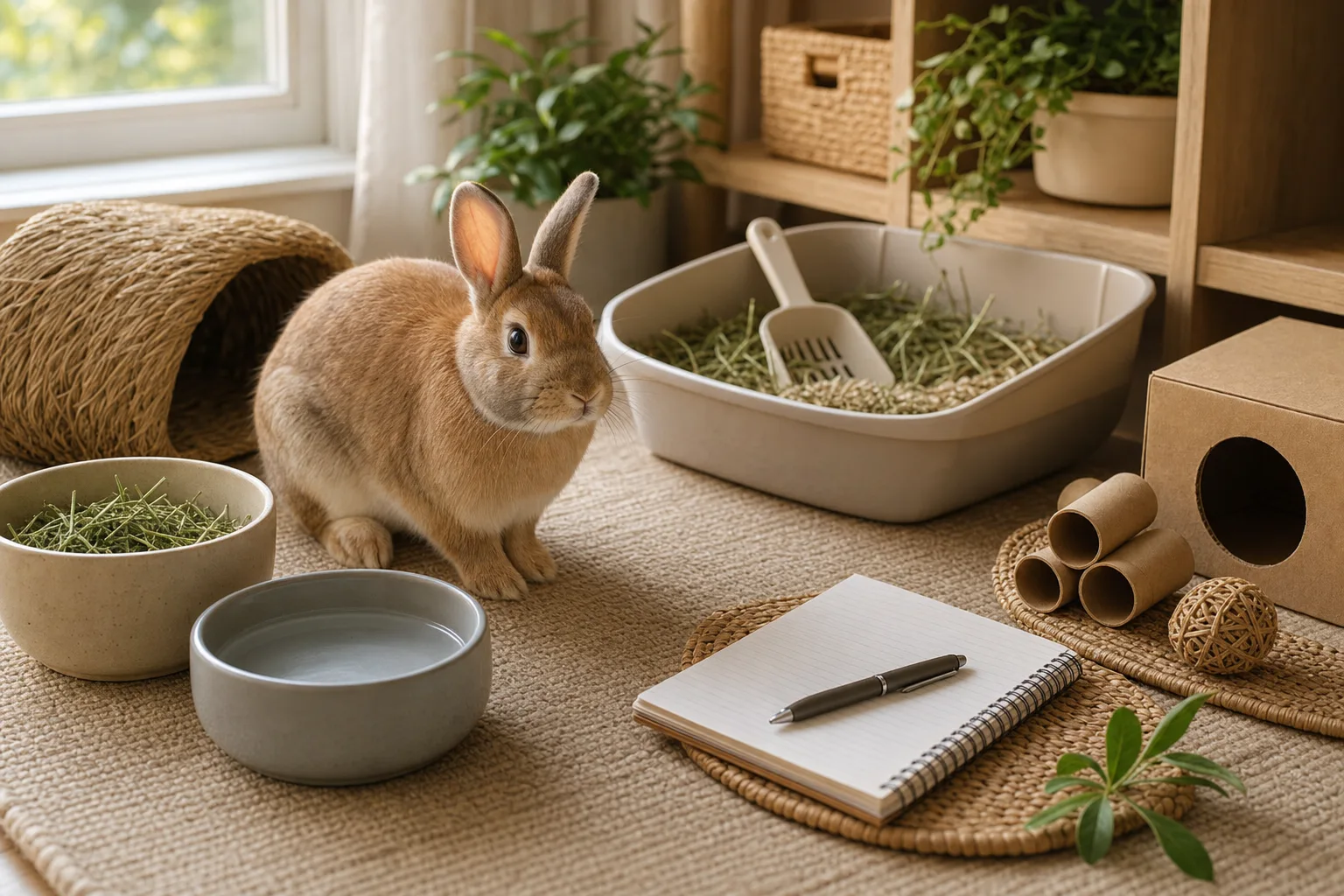
Rabbits litter train faster than almost any other small pet, because the training works with instincts rather than against them. A rabbit already picks specific spots — usually a corner — for urine and most of its droppings, and it prefers to chew hay while it toilets. Give it a large, low-sided tray in the corner it has chosen, keep hay in or beside the tray, and shrink its territory to a size it can keep clean. The habit usually follows within days, and settles over several weeks.
Three things decide how quickly it clicks, and none of them is the rabbit's intelligence:
- Whether it is neutered. House Rabbit Society and PDSA both name neutering as the single biggest factor. Unneutered rabbits mark territory with urine and droppings, and no amount of tray discipline outruns hormones.
- Tray size and access. A tray the rabbit can turn around in, with one low side, gets used. A tiny corner pan marketed for "small animals" gets ignored.
- How much space you handed over too early. Full-room access before the habit is reliable is the most common self-inflicted setback — you are asking a rabbit to keep a territory clean that it cannot patrol.
What litter training is not is a promise of 100% tidy. Rabbits drop the occasional dry pellet outside the tray as deliberate marking, especially around their own space. That is normal, it is easy to sweep, and it is not a training failure.
Why rabbits are cleaner than people expect
Rabbits live close to the ground and keep the area where they eat and rest clear of waste; left to themselves, most choose a toilet corner within days. Litter training is the job of noticing where they have chosen and putting a tray there before the choice hardens into habit.
Age cuts the other way from what most owners assume. The House Rabbit Society is blunt about it: older rabbits are actually easier to train than babies, because they already toilet in predictable places, and PDSA makes the same point about training an older rabbit. Kits have small bladders and no routine; adolescents have hormones. The sweet spot is a mature, neutered adult with a settled daily rhythm.
Adolescence is the predictable wobble: from roughly three to six months, hormones arrive and previously tidy rabbits start spraying and scattering droppings. Habits usually return on their own once the neuter is done.
Choose the tray before you change the habits
Tray choice is where most setups fail before training even starts. The spec is simple, and both welfare organisations agree on it in detail:
| Feature | What to aim for | Why it matters |
|---|---|---|
| Size | Long enough to turn around and stretch out; a medium or large cat pan, or an under-bed storage box for large breeds and bonded pairs | A rabbit toilets in a relaxed, full-body posture — a cramped tray is used once and abandoned |
| Sides | One low entry side, with the back wall roughly 10–20 cm high (PDSA) | Easy hopping in and out, while the higher back contains hay and stray pellets |
| Material | Plastic, wiped or rinsed easily | Metal or wire bottoms hurt feet and can cause sore hocks; grates trap waste and build ammonia |
| Hay access | A rack or a pile at one end of the tray, or immediately beside it | Rabbits chew and toilet at the same time; hay turns the tray into a place the rabbit wants to be |
| Number | Ideally one tray per rabbit; bonded pairs can share if both fit with room to move | Shared trays that are too small create conflict and accidents |
| Avoid | Wire-mesh or grated bottoms, tiny corner pans, covered boxes with one narrow entry | Discomfort and trapped waste are the two fastest routes to avoiding the tray |
For an older or disabled rabbit, cut a lower entry side or add a mat under the front edge so it can step in without a hop. The Enclosure Size Checker is the companion calculation: the tray has to fit inside a space the rabbit can still patrol comfortably.
What goes in the tray
You need less litter than you think. A thin layer is enough to absorb moisture; the hay on top is what sells the tray. House Rabbit Society describes three filling setups that all work, and the difference between them is mostly how often you clean:
| Filling | How to build it | Change it |
|---|---|---|
| Newspaper base | About eight sheets of newspaper, covered with a 3-inch layer of hay or straw | Daily — paper alone does not absorb |
| Litter plus hay | 1–2 inches of rabbit-safe litter, topped with 2–3 inches of hay | Every two days or more |
| Litter or shredded paper alone | A thin layer, with a treat or toy placed in one corner to make the tray interesting | Daily for paper-only; longer for absorbent pellets |
Litter type matters more than litter depth, because rabbits spend a lot of time in the tray and will sample anything they can reach. PDSA recommends paper-based litter, alfalfa, straw or hay, and is explicit that wood shavings should be avoided for respiratory reasons. House Rabbit Society adds the materials to rule out entirely:
| Material | Verdict | Reason |
|---|---|---|
| Paper-based pellets or shredded paper | Safe — the default choice | Soft, absorbent, and low risk if a few fibres are swallowed |
| Compressed paper or wood-pulp pellets (non-clumping) | Safe | Strong odour control, low dust, holds up to digging |
| Wheat- or grass-based litters | Safe | Biodegradable and gentle on paws |
| Hay, straw or alfalfa as the litter itself | Safe | Edible, and it doubles as the feeding spot PDSA recommends |
| Clay or clumping cat litter | Avoid | Swallowed clumping litter can block the gut — a surgical emergency |
| Pine or cedar shavings | Avoid | Aromatic oils irritate the respiratory tract and can affect the liver |
| Corn cob or walnut shell litter | Avoid | Moulds easily and absorbs poorly |
Never let a rabbit share a cat's tray. Beyond the clumping-litter risk, infected cat faeces can carry parasites such as toxoplasmosis, giardia and cryptosporidiosis that are dangerous to rabbits. If you want to read more about how hay and diet choices connect to what comes out the other end, the beginner diet guide and the hay comparison cover the input side.
The first two weeks, step by step
PDSA sets out a sequence that works as written, and House Rabbit Society's advice on space fits inside it. Do these in order rather than all at once:
- Shrink the territory with barriers. Close the rabbit into its pen or a small, safe area. You are not punishing it; you are giving it a space small enough to keep clean.
- Find the corner it already uses. Watch for a day if you have to. Put the tray there — not where the tray looks best to you.
- Seed the tray. Drop in a few droppings and a handful of urine-soaked bedding so the tray reads as a toilet rather than furniture.
- Add hay in or beside the tray and give a small treat when the rabbit hops in. Chewing and toileting are one behaviour for a rabbit; use that.
- Clean accidents promptly and properly. An unscented pet-urine cleaner or biological washing powder in water removes the chemical trace that invites remarking. Soap and water alone leaves enough scent behind to trigger a repeat.
- Extend the space only when the tray is used consistently. Open the pen, then one room, then the rest — each step earned. Too much freedom at once is the classic reason training stalls, and it is reversible: shrink the space again and rebuild.
Expect days rather than hours. House Rabbit Society notes that good toilet habits can take several weeks or even months depending on maturity — a perfectly housetrained six-week-old does not exist.
Accidents: what the pattern tells you
Not every accident is the same problem, and the fix depends on which one you are looking at. This table maps the pattern to the usual cause and the first move. The accident troubleshooting guide goes deeper on the behaviour cases, and the tray setup guide covers the equipment side.
| What you are seeing | Most likely cause | First move |
|---|---|---|
| A few dry droppings scattered outside the tray | Normal territorial marking, especially in the rabbit's own safe zone | Sweep them up; no training change needed |
| Urine in one consistent new spot | The rabbit has picked a corner you have not equipped — or you moved its tray | Add a second tray in that spot rather than fighting the preference |
| Spraying and mess at around 3–6 months | Puberty: hormonal marking in an unneutered rabbit | Book the neuter; habits usually return afterwards |
| Habits collapse after a change | A new pet, a new home, moved furniture, or bonding introductions | Shrink the territory again, keep the routine boring, allow weeks to settle |
| Accidents on the bed or sofa | Marking a soft, high-value surface, or a toileting preference | Fence or cover the surface, reward every voluntary tray visit |
| Dribbling drops while hopping, straining, or a wet bottom | Possible urinary tract infection or another medical cause | Vet visit — this is not a training problem |
Two patterns in that table deserve a closer look. The first is the sudden change in a rabbit whose habits were previously excellent: a urinary tract infection is a real possibility, and it is diagnosed by a vet, not by stricter training. The second is the bonded pair, whose habits often wobble during introductions and then recover. Chronic poor habits in an otherwise healthy rabbit can also point at an underlying problem, which is why routine vet care belongs in the same conversation as training.
How many litter trays does a home need?
Start with one tray inside the pen, sized generously. From there the rules are practical rather than strict:
- One tray per rabbit is the baseline; bonded pairs often share happily, but only if the tray is large enough for both to be inside it at once with room to move (PDSA).
- One storey, three to four rooms is usually covered by a single tray in the rabbit's enclosure (House Rabbit Society).
- More rooms or more than one floor is where a second tray earns its place — rabbits get lazy about crossing a home to toilet, so if a rabbit is consistently using one spot, the honest answer is often to equip that spot.
- Out-of-pen accidents that keep repeating are a tray placement problem first and a behaviour problem second, with medical causes ruled out by a vet.
Keep every tray on the same cleaning rhythm. A tray left too long stops being the clean spot rabbits prefer, and the habit degrades with it — the enclosure cleaning guide covers the whole routine.
When it is not a training problem
Three situations sit outside training and belong with a vet or a behaviour change, not a stricter routine:
- Symptoms alongside the accidents: straining, dribbling, blood in urine, a wet or soiled bottom, or a rabbit that is off its food. Appetite and droppings are the two fastest health signals a rabbit owner has — the not-eating warning signs and the GI stasis guide explain what to watch for.
- Intense marking in an unneutered adult: no amount of tray work fixes hormones. Neutering is the intervention, and the timing conversation is covered in male vs female rabbits.
- A brand-new rabbit with no history: an adopted adult may have never been given a tray, or may have been kept on wire. Give it the setup and the space limits above, and judge it after a few weeks, not a few days. The first-30-days checklist sequences the rest of the settling-in work.
None of this is about a difficult rabbit. Litter training rewards a setup that matches how rabbits actually behave: a tray where they already go, hay where they eat, a territory they can keep clean, and enough time for a routine to form.
References and further reading
- House Rabbit Society — Rabbit Litter Training FAQ: tray sizing, safe and unsafe litters, marking, cleaning accidents, and when accidents signal illness.
- House Rabbit Society — Natural Routines: Litterboxes (Marinell Harriman): how long training takes, the three tray-filling options, and cleaning frequency.
- PDSA — How to litter train a rabbit (February 2023, written by PDSA vets and vet nurses): the six-step method, tray dimensions, and the neutering and shared-tray questions.
Related resources
Grooming & Cleaning
How to Set Up a Rabbit Litter Box That Encourages Good Habits
Choose box size, litter, hay placement, cleaning rhythm, and layout fixes that support litter training.
Grooming & Cleaning
Rabbit Litter Training Accidents: Causes and Fixes
Diagnose accidents with layout, territory, box comfort, health clues, and cleaning strategy before assuming stubbornness.
Grooming & Cleaning
How to Clean a Rabbit Enclosure Without Stressing Your Rabbit
How to clean a rabbit enclosure: how often welfare guidance says to clean, safe products, litter tray hygiene, bedding and flooring choices.
Grooming & Cleaning
Rabbit Grooming Basics: Brushing, Nails, and Messy Bottoms
Keep grooming calm with molt-aware brushing, safe nail checks, and clear boundaries on bathing.