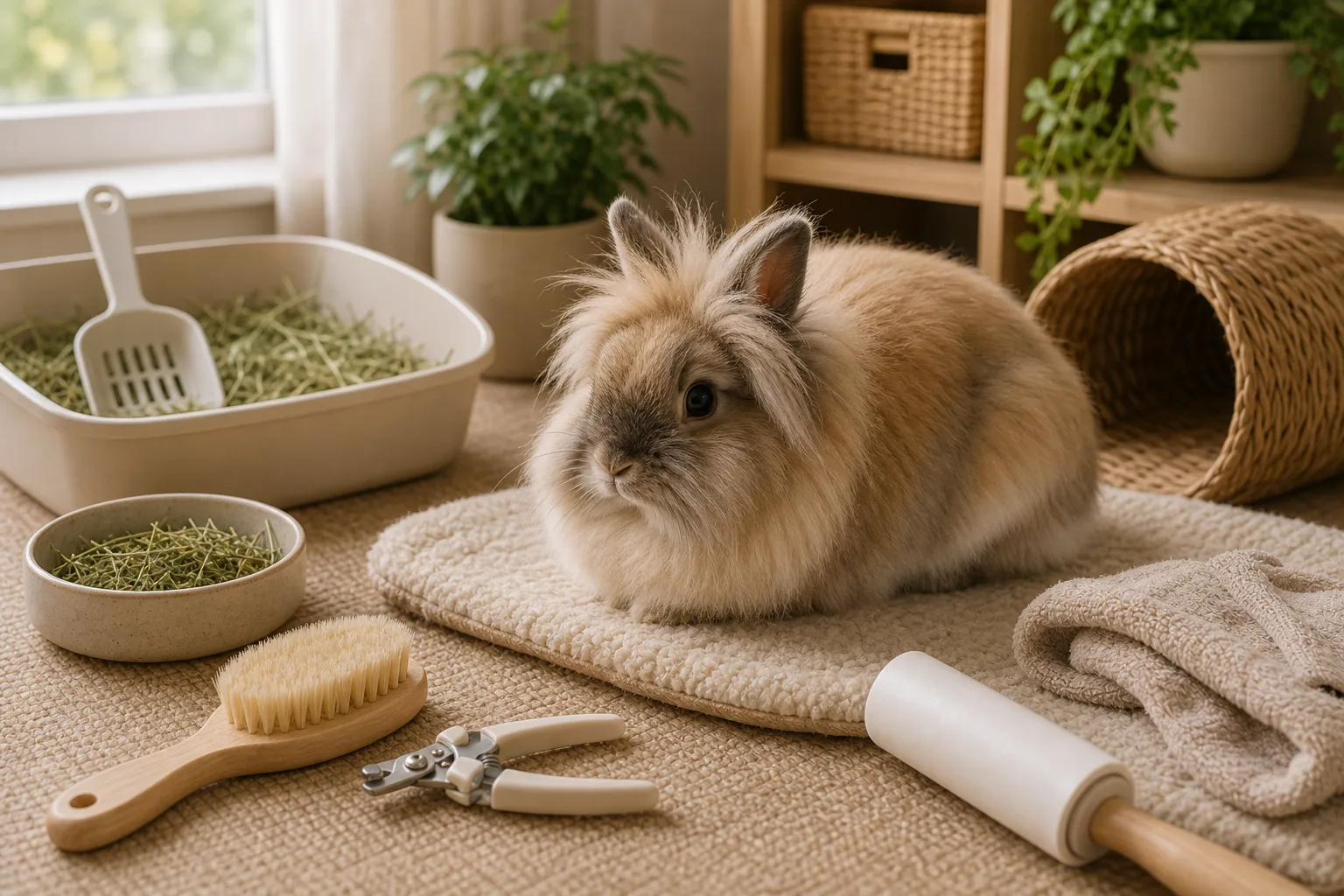
The short answer
A nail trim goes wrong for one reason: nobody told you where the quick is. The Rabbit Welfare Association & Fund (RWAF) states that a vein and a nerve run up each nail and have to be avoided. Pale nails show it; dark nails do not — which is why a torch, a gentle squeeze with the clippers, and permission to stop early matter more than speed.
- Know the count. The RWAF: rabbits have five toes on their front feet and four on their back feet — 18 nails, not 10.
- Use rabbit clippers. The RWAF warns ordinary scissors or human clippers can split the nails and hurt the rabbit; PDSA says the same.
- Trim a little. PDSA: cut a couple of millimetres clear of the quick. For overgrown nails the RWAF recommends nibbling — a tiny amount twice a week while the quick recedes.
- Never hold a rabbit on its back. The RWAF is explicit: there is no need to turn rabbits upside down to cut their nails.
- Have a plan for a slip. If you catch the quick, the RWAF and PDSA both say to dab the nail into cornflour to stop the bleeding; Best Friends suggests styptic powder and cotton-wool pressure.
How many nails a rabbit has, and where
The RWAF states it directly: five toes on the front feet, four on the back. That is 10 nails at the front and 8 at the back.
| Where | Per foot | Total | What it means at trim time |
|---|---|---|---|
| Front feet | 5 | 10 | The fifth toe sits higher up the inside of the leg and is the one people miss; run a finger down the leg every time. |
| Hind feet | 4 | 8 | Longer, thicker nails that take the body weight — and the ones the RWAF links to sore hocks when they change how the foot sits. |
| All four | — | 18 | Count them on the first trim. A missing, split or curved nail is a finding worth recording. |
One number matters more than the count: 18 nails, checked weekly. The RSPCA says front teeth and nails should be checked at least once a week as these can grow quickly, and lists "nails of an appropriate length" among a rabbit's welfare needs.
Why pet rabbits need trims at all
The RWAF explains the mismatch: rabbit nails are very tough because they are built for digging burrows, and wild rabbits keep them short by digging and hopping over rocks and hard ground. A pet rabbit living on carpet, laminate or fleece-lined pen often has nothing to wear them down. What follows shows up in the feet, not the nails:
| What happens | Why it matters |
|---|---|
| Long nails change the angle at which the rabbit puts its feet down (RWAF). | With the hind feet no longer sitting properly, weight is forced back onto the heels — the RWAF's route to sore hocks, or pododermatitis. |
| Long nails snag easily and can be torn, sometimes right out of the nail bed (RWAF). | This is the injury behind most "my rabbit's nail came off" searches, and it is preventable with length control. |
| Nails grow very long and sharp and become uncomfortable (House Rabbit Society). | The HRS is clear that house rabbits on carpet and linoleum periodically need their toenails trimmed, in the same way as dogs and cats. |
Flooring is not the only variable. The RSPCA warns Rex rabbits have less fur protection on their feet and may need soft, dry flooring and careful weight monitoring to prevent sore hocks — so for a Rex, nail length is part of foot care. Surfaces are covered in the indoor housing setup guide.
How often: what each organisation publishes
| Source | What it publishes |
|---|---|
| Merck Veterinary Manual | Nails trimmed every 1–2 months or as needed — the veterinary baseline for an average adult rabbit on soft flooring. |
| Best Friends Animal Society | Check the nails at least every four to six weeks; checking and trimming are separate jobs, and the check is the frequent one. |
| RSPCA | Check nails at least once a week — that is how a snagged or split nail is caught before it tears. |
| Blue Cross | Most rabbits need regular trimming; ask your vet to show you how. The interval is individual. |
| RWAF | Watch nails as part of regular checks; if you are not confident, ask your vet or vet nurse. For overgrown nails, short repeated trims beat one big correction. |
The interval depends on the rabbit, not the calendar: nails need trimming sooner on a young rabbit on soft flooring, on an elderly or less mobile rabbit that wears them less, and on a rabbit carrying extra weight. Practical test: if you can hear the nails clicking on a hard floor, or see them curling when the rabbit sits, it is time.
What to have ready before you start
Most bad trims are a kit problem, not a technique problem. Set everything out first.
| Item | What the sources say |
|---|---|
| Rabbit nail clippers | The RWAF accepts two types: a scissor design with a notched section for the nail to sit in, and a guillotine; Best Friends suggests the guillotine sold for cats and birds. Ask your vet to order a good pair while they show you the technique. |
| Ordinary scissors, human clippers | Not in the kit. The RWAF says they can split the nails and hurt the rabbit; PDSA says they will damage rabbit claws. |
| A small torch | The RWAF's method for dark nails: shine it from behind the nail so the light shows where the quick ends. Best Friends suggests a penlight through the nail. |
| Cornflour or styptic powder | Cornflour clots a nicked quick — named by both the RWAF and PDSA. Best Friends adds styptic powder and cotton wool for direct pressure. |
| A towel, a non-slip surface, good light | PDSA asks for a rabbit that is comfortable and secure on a non-slip surface; the RWAF's towel-on-a-worktop method needs a surface the rabbit cannot slide across. |
Finding the quick on pale and dark nails
PDSA describes the quick as the bit inside the nail containing blood vessels and nerves, which is why cutting it bleeds and hurts. Locating it differs by nail colour.
| Nail colour | How to find the quick | Where to cut |
|---|---|---|
| Pale or translucent | Shows as red or pink inside the nail (PDSA); the HRS notes the blood is visible in pale nails, and the RWAF calls them the easy ones. | PDSA: a couple of millimetres away from the quick. Best Friends: right before the quick, but not too close. |
| Dark or black | A small torch from behind the nail, watching where the light stops showing the quick (RWAF); a penlight through the nail (Best Friends). PDSA's fallback is to estimate from a pale nail. | Less than you think, then look again. If every nail is dark, PDSA's advice is to ask your vet rather than guess. |
| A mix of both | Read the pale nails first and use them as the reference for the dark ones on the same rabbit. | When in doubt take a sliver. A second pass in a few days is harmless; a nicked quick is not. |
The most useful trick in the RWAF's guide: where you think it is safe, give the nail a gentle squeeze with the clippers before cutting. If the rabbit reacts, you are too near the quick — move further out, and repeat on every nail.
Positioning: how to hold a rabbit safely
The posture people reach for first is the one the RWAF warns against. Its nail guide has a note on "hypnotising" or "trancing": some people hold a rabbit on its back so it goes perfectly still, as if in a trance. The RWAF's conclusion: there is no need to turn rabbits upside down to cut their nails. Both positions it describes are upright — hold the rabbit with its backside supported as if sitting up, or place it on a towel on a worktop and very gently pull the foot to the side to reach the nails. PDSA's version is the comfort check: comfortable and secure on a non-slip surface before you cut anything.
A scrabbling rabbit is how nails get torn rather than trimmed. Keeping a rabbit calm is a skill in its own right: bonding and trust, calming a stressed rabbit, and body language basics cover the groundwork and the signals that say stop now.
A calm trim, step by step
- Check before you cut. Go through all 18 nails looking for snags, splits, curves, missing nails and sore patches on the sole. That is the RSPCA's weekly habit — not the trimming.
- One foot at a time. Front feet first is common; the RWAF's towel method makes the hind feet easier. Do not swap feet mid-nail.
- Find the quick. Read the pink line on pale nails; use a torch or a pale nail as reference on dark ones; squeeze gently with the clippers first.
- Take a small bite. PDSA's two millimetres from the quick is the standard. Cut straight across.
- Look again before the next nail. Nails on the same rabbit differ. The one that looked short on the first foot may be long on the second.
- Stop while it is still going well. PDSA is direct: do not force your rabbit to have its nails cut. If it is struggling, contact your vet for advice.
- Finish on a good note. PDSA suggests making it a positive experience. A treat after a calm foot beats a treat coaxing a frantic one.
For a badly overgrown rabbit the RWAF's answer is not to chase the ideal length in one session. If the nails are very long and the quick sits high, clip a tiny bit twice a week, or every other day: the quick recedes as the nail shortens and the nails reach a comfortable length without a single risky cut. That is the argument for a vet-led first trim — they can show you the squeeze test, the torch position and the target length on your own rabbit. Nails sit inside the wider grooming routine, so pair the two.
If you cut the quick, or a nail bleeds
It happens. The RWAF notes that a cut quick will be painful for the rabbit and there will be a lot of blood — alarming in the moment, rarely dangerous if you deal with it calmly.
| Situation | What the sources advise |
|---|---|
| You nicked the quick | Dab the nail into cornflour to stop the bleeding (RWAF; PDSA says the same). Best Friends adds styptic powder. |
| Still bleeding | Hold cotton wool around the nail until it stops (PDSA); Best Friends uses direct pressure with a cotton ball. |
| The rabbit is struggling | Stop. PDSA: do not force it — if you are struggling, contact your vet for their advice. |
| It keeps bleeding, or the nail looks damaged | A vet call, not another attempt: bleeding that will not settle with pressure, a nail torn at the base, or a swollen painful toe all belong with a vet. |
Two practical notes: do not finish the remaining nails while the rabbit is still upset — use the RWAF's nibbling approach on another day; and clean the foot afterwards, because a sticky foot collects litter. If a visit is needed, the vet visit prep guide covers the carrier and timing.
A torn, snagged, or missing nail
The RWAF explains why it happens: long nails snag easily and can be torn, sometimes right out of the nail bed. A nail caught in carpet, a blanket, a pen panel or a carrier grille tears at the point of least resistance — often the base rather than the tip. Four things the sources support:
- The risk scales with length. Nails kept at the length the RWAF describes — worn or trimmed so the feet sit at the proper angle — remove most of the snagging risk.
- Bleeding is managed the same way: cornflour or cotton-wool pressure (PDSA), or styptic powder (Best Friends).
- A nail torn at the base is not a home job. The RWAF's answer for anything you are not confident about is the same throughout its guide: ask your vet or vet nurse. A partly detached nail left hanging, or a toe that is swelling, needs assessment rather than another attempt with the clippers.
- Check the whole foot. Sore hocks are inflammation of the feet caused by friction, pressure or damage (RSPCA), so a rabbit favouring a foot or sitting differently is showing you the foot as well as the nail.
If a nail is completely gone, keep the foot clean and dry, check daily for swelling, discharge or heat, and book the rabbit in if anything looks wrong.
Overgrown nails, sore hocks, and the foot-angle link
Nail length is not cosmetic. The RWAF describes a three-link chain: long nails change the angle at which the rabbit puts its feet down; with the hind feet no longer sitting properly, weight is forced back onto the heels; and that load on the heel is one of the routes to sore hocks. The RSPCA describes pododermatitis as inflammation of the feet caused by friction, pressure or damage to the skin, and puts prevention in the setup — solid, non-slip flooring and soft surfaces to protect the feet.
So the target is not "nails shorter than they are" but nails short enough that the feet sit at a normal angle on the surface the rabbit actually lives on. The rabbit care checklist is a sensible home for the weekly check, and the enclosure cleaning guide covers the other half of foot hygiene.
When to hand it to a vet
Every organisation in this guide gives a version of the same answer: if you are not confident, it is a vet or vet-nurse job, not a personal failure. Book one when:
- Every nail is dark and you cannot read the quick. PDSA's own instruction is to ask your vet for advice in exactly this case.
- The nails are badly overgrown. A vet or vet nurse can show you the first pass on your rabbit rather than on a diagram.
- The rabbit fights a trim. PDSA says do not force it; the RWAF says ask your vet or vet nurse if you are not confident.
- A nail is torn, hanging, or the toe is swollen. That is damage, not grooming.
- The rabbit is off its food or its droppings have changed. An unwell rabbit should not be fighting a grooming session — see the not-eating warning signs and the GI stasis guide, plus the new owner checklist.
A clinic will also trim nails for you if you would rather not do it at all. The HRS notes your veterinarian will clip nails for you, and Best Friends makes the same point: your veterinary clinic can do it or point you to local options. A first appointment is also the cheapest way to learn the technique — see vet care basics.
Common mistakes
- Human clippers or household scissors. The RWAF says they can split the nails and really hurt the rabbit; PDSA says they damage rabbit claws. The most common equipment error there is.
- Trimming a struggling rabbit to get it done. A moving target is how a quick gets nicked and a nail gets torn; PDSA's instruction is to stop and ask for advice.
- Turning the rabbit on its back. The RWAF states there is no need to turn rabbits upside down to cut their nails — the supported-sitting and towel positions exist so you do not have to.
- Cutting a long nail to target length in one pass. When the quick is high, that is a guaranteed nick. Use the RWAF's nibbling method — and if every nail is dark and you cannot see or shine a light through the quick, PDSA's advice is your vet, not a shorter cut.
- Forgetting the fifth front toe. Five nails on each front foot means one sits higher up the leg, easy to miss entirely — and that is the one that grows long and snags.
- Declawing. The HRS states it is definitely not recommended for rabbits because of infection risk, and the Merck Veterinary Manual is blunter: rabbits should never be declawed.
References and further reading
- RWAF — Rabbit Nails: nails as digging tools, the changed foot angle, snagging and tearing out of the nail bed, the sore-hock link, the vein and nerve in each nail, the torch method, the squeeze test, the nibbling technique, never turning a rabbit upside down, and cornflour for a nicked quick.
- RWAF — Grooming: five toes at the front and four at the back, scissor-type (notched) and guillotine clippers, and the warning against ordinary scissors and human clippers.
- House Rabbit Society / Rabbit.org — Grooming: house rabbits on carpet and linoleum needing periodic trims, long sharp nails as a discomfort, the blood visible inside pale nails, and the declawing warning.
- PDSA — How to clip your rabbits' nails: rabbit clippers over scissors or human clippers, the secure non-slip position, the quick's blood vessels and nerves, cutting a couple of millimetres clear, estimating from another nail on dark nails, and cornflour or cotton wool for bleeding.
- RSPCA — Rabbit health: teeth and nails checked at least weekly, nails of an appropriate length as a welfare need, pododermatitis causes and prevention, and the Rex foot caution.
- Blue Cross — Caring for your rabbit: most rabbits needing regular nail trimming, and asking your vet to show you how.
- Merck Veterinary Manual — Routine Health Care of Rabbits: nails trimmed every one to two months or as needed, and the statement that rabbits should never be declawed.
- Best Friends Animal Society — Rabbit Grooming: checking nails at least every four to six weeks, the guillotine clipper sold for cats and birds, the penlight for dark nails, cotton-ball pressure and styptic powder, and using your veterinary clinic for trims.
Related resources
Grooming & Cleaning
How to Clean a Rabbit Enclosure Without Stressing Your Rabbit
How to clean a rabbit enclosure: how often welfare guidance says to clean, safe products, litter tray hygiene, bedding and flooring choices.

Grooming & Cleaning
How to Set Up a Rabbit Litter Box That Encourages Good Habits
Choose box size, litter, hay placement, cleaning rhythm, and layout fixes that support litter training.
Grooming & Cleaning
Rabbit Grooming Basics: Brushing, Nails, and Messy Bottoms
Keep grooming calm with molt-aware brushing, safe nail checks, and clear boundaries on bathing.
Grooming & Cleaning
Rabbit Shedding and Molting: When It Is Normal and When to Worry
Handle heavy molts with brushing, monitoring, and warning signs that deserve veterinary attention.