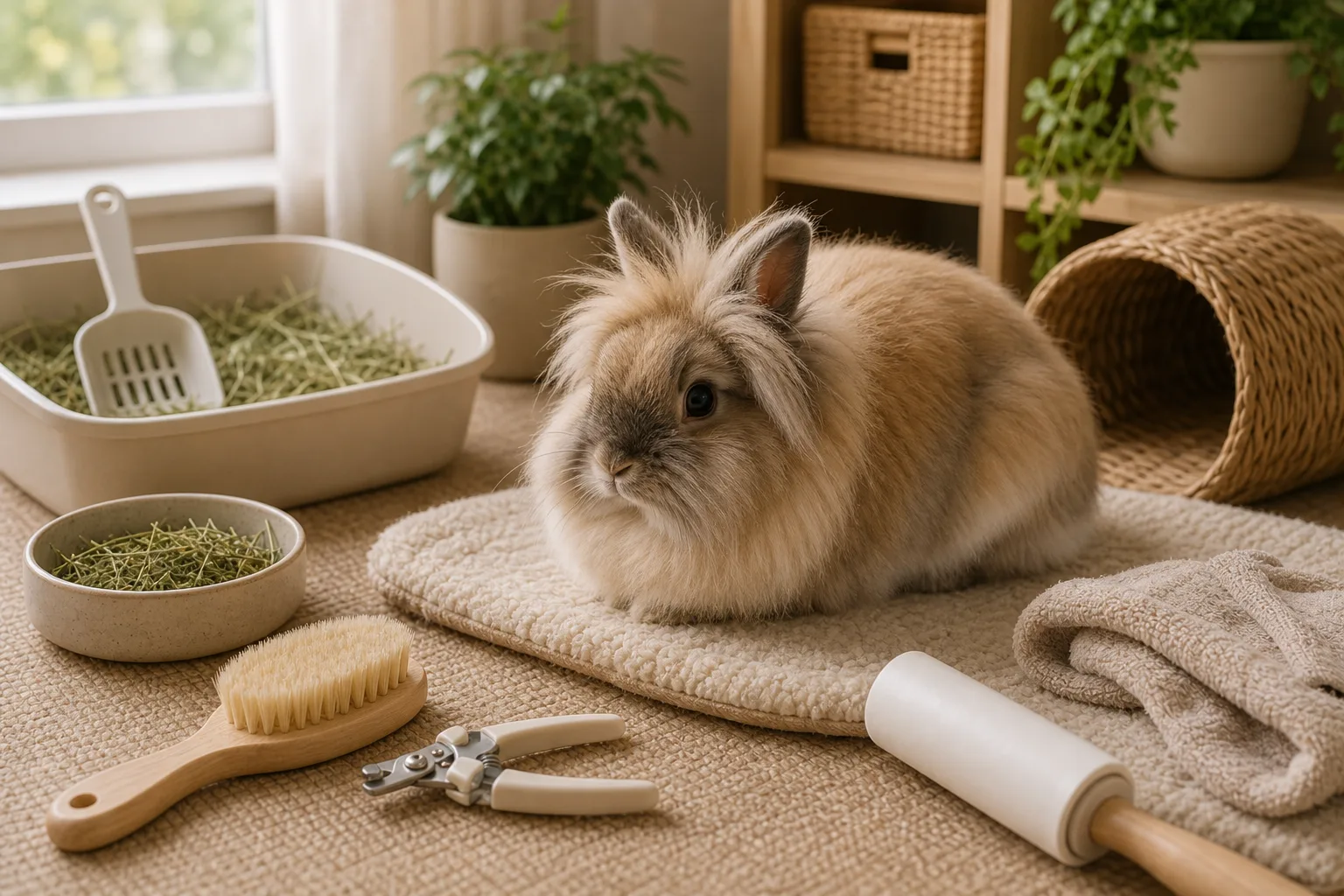
The short answer
Shedding is normal; the work it creates is a grooming and gut-management problem, not a coat problem. The Rabbit Welfare Association & Fund (RWAF) puts the timing on it: a rabbit's baby coat is replaced at around five months by a transitional coat, and from then on rabbits generally moult twice a year, in spring and autumn. Domestic rabbits, and especially house rabbits, do not follow that neatly — many appear to moult almost constantly.
- Brush more often, and brush properly. The RWAF says it may be necessary to brush more than once a day during a moult, and that you need to brush down to the skin, parting the fur as you go, to remove the undercoat being shed and not just the fur sitting on top of it.
- Keep hay and water in front of the rabbit. Swallowed coat hair only becomes a problem when the gut slows, which is why the RWAF calls constant access to hay and grass vital — and even more so during a moult.
- Read the droppings daily. Small, dry or fewer droppings are the warning; droppings strung together on strands of hair are normal while the rabbit is eating well and passing plenty of large droppings.
- Do not bath. Blue Cross states that rabbits keep themselves very clean and should not need a bath, and the House Rabbit Society (HRS) notes a thoroughly wet rabbit takes a very long time to dry.
- Know the one thing that is not normal. PDSA: rabbits often moult in big tufts but should not go bald. Fur loss that leaves bare skin is a symptom to show a vet, not a heavy shed.
How rabbit shedding actually works
Two published patterns sit behind almost every question owners ask. The RWAF describes an orderly progression: moulting typically starts at the head, spreads down the neck and back, then down the sides of the body, and finishes at the rump. Some rabbits skip the order entirely and lose fur in patches all over at once, and many show a visible tide line — a line across the coat where the moult is advancing, with darker skin showing where new fur is growing through. The House Rabbit Society describes a different rhythm: rabbits shed roughly every three months, alternating a light shed that may barely be noticeable with a heavy one you cannot escape.
| What you see | Published pattern | Source |
|---|---|---|
| Timing through life | Baby coat replaced at around 5 months by a transitional coat; adult coat then moults roughly twice a year, spring and autumn | RWAF |
| House rabbits | Domestic rabbits have a more variable pattern than wild ones; house rabbits in centrally heated homes often appear to moult constantly, especially heavy-coated breeds | RWAF |
| Order of the shed | Head first, then neck and back, then the sides of the body, finishing at the rump | RWAF |
| Tide line | A visible line across the coat marking where the moult is progressing, often with darker skin where new fur is coming through | RWAF |
| Cycle length | Rabbits shed about every three months, alternating a light shed with a heavy one | House Rabbit Society |
| Speed of release | Some rabbits take a couple of weeks or more to lose the old coat; others get rid of it in a single day and cannot be neglected once they start | House Rabbit Society |
| Bald patches during a shed | Bald spots are quite common while shedding and, when they come from the shed itself, begin to grow back within a week or two | House Rabbit Society |
| Going bald overall | Rabbits often moult in big tufts but should not go bald | PDSA |
That last row is the dividing line: everything above it is coat maintenance, while fur lost down to the skin is hair loss, which PDSA treats as a symptom with its own list of causes.
A grooming routine for shedding season
The published frequencies differ because the coat types differ, not because the sources disagree. Blue Cross gives the baseline: rabbits with short coats should be groomed weekly and even more regularly when they are moulting, while long-haired rabbits need daily grooming because their coats can quickly become matted and uncomfortable. PDSA adds the seasonal version of the same rule — most rabbits groom themselves, but some long-haired breeds need grooming every day, especially when they are moulting. The RWAF's practical target during a shed is daily grooming, more often when the coat is coming out heavily.
| Coat type | Baseline | During a moult | Source |
|---|---|---|---|
| Short-coated rabbit | Weekly | More often than weekly | Blue Cross |
| Any rabbit, routine contact | At least weekly | Multiple brushings a day during a heavy shed | House Rabbit Society |
| Moulting rabbit | — | Daily grooming to reduce the hair passing through the digestive system | RWAF |
| Heavy or awkward shed | — | More than once a day, split into shorter sessions | RWAF |
| Long-haired rabbit | Daily | Daily, without exception | Blue Cross, PDSA |
| Long-haired coat length | Keep hair trimmed to one inch or less | Same standard, or expect recurring hair balls | House Rabbit Society |
Three technique notes matter as much as the frequency. The RWAF asks owners to sit with the rabbit on the ground while brushing, because rabbits are ground-dwelling and do not like being placed at a height, and to break the work into short sessions, which is less stressful than one long one. It also notes that a moult can stall on the flanks, just above the tail, and on the belly, and suggests a cat moulting comb for those areas. Matts you cannot tease out with careful combing should be clipped by a vet, because rabbit skin is delicate and easily torn — and the daily grooming basics routine is where the handling habit gets built.
Brushes and tools that work
Tool choice is published guidance rather than personal preference, and one popular brush type is explicitly warned against.
| Tool | Published guidance | Source |
|---|---|---|
| Slicker brush | Often too harsh for rabbits — the sharp ends easily scratch the skin and should be avoided | RWAF |
| Wide-toothed comb | Very useful for working through the coat | RWAF |
| Cat flea comb | A useful rabbit grooming tool as well as a flea comb | RWAF |
| Brush with blunt-ended metal prongs | Handy; the blunt ends are the point | RWAF |
| Cat moulting comb | The tool the RWAF names for a moult that has stuck on the flanks, above the tail or on the belly | RWAF |
| Soft bristle or rubber brush | Gentle on very delicate rabbit skin and effective at removing loose hair | PDSA |
| Scissors on matts | Do not cut matts out yourself unless you have been shown how and are confident; delicate skin tears and cuts easily | RWAF |
| A bath | Rabbits keep themselves very clean and should not need a bath; a rabbit wet to the skin must be dried thoroughly, undercoat included | Blue Cross, House Rabbit Society |
| Corn starch for spot cleaning | For a dirty patch the House Rabbit Society suggests baby corn starch and a fine comb rather than water — and warns against talcum powder | House Rabbit Society |
One habit belongs with the tools: the RWAF asks owners to get a rabbit used to being brushed before the moult arrives, so the extra sessions are not a shock. If a coat is matted because the rabbit can no longer keep itself clean, that is a signal rather than a grooming task — the RSPCA lists difficulty grooming among the signs of illness, and the body-language basics cover the rest of the discomfort signals.
Hairballs and the gut
This is the part of shedding advice that has changed. Older rabbit writing, including the House Rabbit Society's long-standing grooming page, explains that rabbits lick themselves like cats but cannot vomit, so ingested hair can form a mass that blocks the stomach exit — the classic warning that a rabbit can starve while the stomach looks fat. The RWAF's current position is subtler: rabbits constantly ingest hair through grooming, so finding some hair in the stomach is perfectly normal. Problems occur when the hair dries out because the gut has slowed and the rabbit is dehydrated, which makes the hair ball a secondary problem rather than the usual cause of gut stasis. If the hair ball is the effect rather than the cause, the early signal is the gut itself — which is why the RWAF asks owners to check droppings daily during a moult.
| What you see | What it means | What to do | Source |
|---|---|---|---|
| Droppings strung together on strands of hair | The rabbit is passing the hair through the gut | Fine to monitor as long as the rabbit is eating well and passing plenty of large droppings | RWAF |
| Droppings small and dry, or hard and fewer than usual | A warning that the gut may be slowing | See a vet as soon as possible to prevent a bout of gut stasis | RWAF |
| Droppings stop, or the rabbit is subdued or unwell | Possible developing gut stasis | Urgent veterinary attention | RWAF |
| Eating and drinking habits change | An early illness signal rather than a shedding problem | Talk to your vet straight away | RSPCA |
| Over-grooming, licking and chewing more than usual | One of the symptoms worth reporting alongside fur loss | Report it to the vet with the hair loss | PDSA |
The feed side of the same problem is unglamorous: constant access to hay and grass keeps the gut moving, which matters most during a moult. Pushing hay intake up is the intervention owners control directly — choosing the best hay and the hay-first plate in what rabbits eat both cover how to do it without changing everything at once. If appetite drops instead, treat it as an emergency signal rather than a grooming problem: a rabbit that is not eating and the signs of gut stasis are the two pages to read in that order.
When shedding is not shedding
PDSA publishes the differential list for fur loss in rabbits, and it is long enough that owners should not try to sort it out at home. Its overview is blunt: alopecia is often treatable and rarely permanent, and you should contact your vet if you notice your rabbit losing fur, especially because some causes are irritating or painful.
| Cause | What it looks like | Source |
|---|---|---|
| Moulting | Seasonal fur loss, often in big tufts — normal, but the rabbit should not go bald | PDSA |
| Stress | The rabbit pulls its own fur out; stress is a very common cause of alopecia | PDSA |
| Behavioural / barbering | One rabbit pulls another's fur as an act of dominance; mounting can also cause bald patches | PDSA |
| Fleas, mites and lice | Parasites feeding on skin and fur; the RWAF names Cheyletiella parasitovorax, the fur mite sometimes called walking dandruff, which many rabbits carry with no signs until they cannot keep it in check | PDSA, RWAF |
| Arthritis and other pain | Painful joints lead to over-grooming and pulling at the coat | PDSA |
| Skin infections, wounds and scars | Hair loss is common around infected skin, deep wounds and scars, and can be permanent | PDSA |
| Flystrike | Life-threatening; early alopecia around the backend is a symptom, and flystrike is often fatal | PDSA, RSPCA |
| Dirty or wet bottom | A wet bottom for more than a few days very often leads to alopecia, urine scald and infected skin | PDSA |
| Pregnancy or false pregnancy | Hormone changes cause fur loss and nest-building fur pulling; normal unless the rabbit makes itself bald | PDSA |
| Ringworm, tumours | Ringworm; certain skin, ovarian and testicular cancers (rare) | PDSA |
| Inability to groom | A coat that stops being maintained can itself be the clue — the RSPCA lists difficulty grooming among the signs a rabbit is unwell | RSPCA |
PDSA also lists the accompanying signs worth reporting: changes in behaviour, red or rashy skin, bumps and scabs, smelly skin, dandruff, itching and over-grooming. Dandruff and a scruffy coat are the two that look like shedding at a glance; the difference is that fur mites and skin disease come with itching, redness or skin changes, while a shed leaves healthy skin underneath. One check belongs in the daily routine regardless of season: in warm weather the RSPCA asks owners to check the fur and skin around the rabbit's rear end and tail twice a day, because urine staining or stuck droppings attract flies that lay eggs and cause flystrike — and long-haired rabbits are at greater risk. That habit catches the most dangerous condition on the list above while it is still treatable, and it is already part of the daily care routine and the care checklist tool.
Long-haired and high-shedding rabbits
Coat length changes the arithmetic. Blue Cross warns that long-haired rabbits need grooming every day because their coats can quickly become matted and uncomfortable; PDSA repeats the daily requirement for long-haired breeds, especially while moulting; and the House Rabbit Society gives the working standard for the coat itself — keep long hair trimmed to one inch or less, or expect to be fighting hair balls most of the time. The RSPCA adds the two breed-level exceptions owners most often miss: long-haired breeds need more frequent brushing to prevent matting, and Rex rabbits, which have less fur protection on their feet, need soft, dry flooring and careful weight monitoring to prevent sore hocks.
The coat and foot implications of each breed sit in the breed directory, and the flooring half of that advice sits in the housing setup guide. Keep the resting areas clear of loose fur too — the fur that ends up on the rug ends up back on the rabbit, and a weekly pass over beds and favourite corners is part of the enclosure cleaning routine.
The shedding-season checklist
- Brush daily, and go to the skin. Part the fur and lift the undercoat out, not just the fur on top, and split the work into short sessions (RWAF).
- Brush on the floor. Rabbits are ground-dwelling and dislike being held at a height (RWAF).
- Check the stuck spots. Flanks, just above the tail, and the belly are where a moult stalls; use a cat moulting comb there (RWAF).
- Refresh hay and water first. Constant hay access keeps the gut moving, which is what stops swallowed hair becoming a problem (RWAF).
- Read the droppings. Strung droppings are fine while the rabbit eats well; small, dry or fewer droppings mean a vet visit that day (RWAF).
- Check the rear end twice a day in warm weather for the urine staining and stuck droppings that lead to flystrike (RSPCA).
- Look at the skin, not just the coat. Redness, scabs, itching dandruff or bare skin that is not regrowing belongs on the vet list (PDSA).
- Keep nails and matts on the calendar. Most rabbits need regular nail trimming, and matts you cannot comb out need a vet's clippers, not scissors at home — see trimming rabbit nails (Blue Cross, RWAF).
If any of it starts signalling illness rather than a shed — eating less, quieter than usual, fur loss to the skin — stop treating it as a grooming task and move to what to expect from rabbit vet care, how to prepare for the visit, and, if appetite is involved, the same-day urgency covered in rabbit not eating.
Common mistakes
- Brushing only the top coat. The RWAF's instruction is explicit: remove the undercoat that is being shed, or matts form within the fur.
- Assuming a bald patch is a heavy shed. Rabbits moult in tufts but should not go bald; bare skin goes to a vet (PDSA).
- Bathing to remove loose fur. Blue Cross and the House Rabbit Society both treat this as something rabbits should not need.
- Cutting matts out at home, or reaching for a slicker brush because it works on cats and dogs. Rabbit skin is delicate and the sharp ends scratch; the RWAF advises against both.
- Watching the coat and ignoring the droppings. During a moult the droppings are the earlier and more reliable signal that the gut is coping.
- Changing the diet to fix a shed. Hay intake is the lever; sudden diet changes are a separate risk, which is why new foods are introduced slowly in introducing new greens.
References and further reading
Every figure and rule above comes from the following published sources, read directly:
- Rabbit Welfare Association & Fund — Moulting: the five-month coat change and twice-yearly moult, the head-to-rump progression and tide line, brushing to the skin, brushing more than once a day, sitting on the ground, the slicker-brush warning, the grooming-tool list, the matt-clipping rule, hair balls as a secondary problem, the droppings checks, moults that stick on the flanks, tail and belly, and centrally heated house rabbits moulting constantly.
- House Rabbit Society / Rabbit.org — Grooming: shedding roughly every three months, alternating light and heavy sheds, at least weekly brushing, the two-week versus one-day coat release, bald spots that regrow, trimming long hair to one inch or less, and corn starch rather than water for spot cleaning.
- PDSA — Hair loss (alopecia) in rabbits: the full differential list of causes, the moulting-in-tufts-but-not-bald standard, and the accompanying symptoms worth reporting to a vet.
- PDSA — Keeping your rabbit healthy: brushing to keep the coat healthy, daily grooming for long-haired breeds especially when moulting, and the daily check that includes a dirty bottom.
- RSPCA — Rabbit health: brushing regularly to keep the coat in good condition, the twice-daily rear-end check and the flystrike risk, the extra brushing long-haired breeds need, the Rex foot-and-flooring caution, and difficulty grooming as a sign of illness.
- Blue Cross — Caring for your rabbit: weekly grooming for short coats and more often when moulting, daily grooming for long-haired rabbits, the no-bath rule, and regular nail trimming.
Related resources
Grooming & Cleaning
How to Trim Rabbit Nails Safely and Calmly
How to trim rabbit nails safely: how many nails a rabbit has, finding the quick on pale and dark nails, what to do if it bleeds, and when to see a vet.
Grooming & Cleaning
Rabbit Grooming Basics: Brushing, Nails, and Messy Bottoms
Keep grooming calm with molt-aware brushing, safe nail checks, and clear boundaries on bathing.

Grooming & Cleaning
Rabbit Litter Training Accidents: Causes and Fixes
Diagnose accidents with layout, territory, box comfort, health clues, and cleaning strategy before assuming stubbornness.
Grooming & Cleaning
How to Clean a Rabbit Enclosure Without Stressing Your Rabbit
How to clean a rabbit enclosure: how often welfare guidance says to clean, safe products, litter tray hygiene, bedding and flooring choices.